AI Code Review Tool That Prevents Bugs: Practical Guide

Ai code review tool that prevents bugs sounds great until your agent ships a neat refactor that passes tests and still breaks the one caller nobody traced. You’ve probably seen it: Claude Code or Cursor edits the right file, but misses the path that actually matters.
What helps is not more PR comments. It’s knowing what depends on the thing you’re changing, whether the new code is reachable, and whether the helper already exists (usually by the 3rd duplicate util, teams feel this hard).
A few checks separate "looks fine" from safe:
- Trace downstream callers before touching shared functions or request contracts.
- Search the repo for existing logic before letting your agent write another version.
- Verify new handlers, jobs, and exports are wired into a real production path.
Read this, and you’ll catch more of the stuff that actually breaks.
The Real Problem With AI Code Review Today
You’ve probably seen this already. Claude Code or Cursor makes a clean refactor, the diff looks reasonable, tests pass locally, and then some downstream endpoint breaks because the agent never saw the full call chain.
That’s the tension now. Code generation got much faster. Review confidence didn’t.
A lot of teams expected AI review to shrink review time. In practice, PRs got bigger, more frequent, and often harder to trust. You end up reading more, not less, because the tool helped create more change than anyone can safely reason about from a diff alone.
The skepticism is justified:
- many AI review tools inspect changed lines, not system structure
- comments show up after the risky change already exists
- file-by-file exploration burns context window and still misses relationships
- small diffs can hide large architectural impact
Most code review tools catch problems after they ship. That’s backwards.
An ai code review tool that prevents bugs should do something earlier and more useful: show hidden impact before the change lands. Not just “this line looks risky,” but “this utility is called by six handlers and two cron paths” or “this new helper duplicates logic that already exists three modules over.”
That’s a different job. And it’s the one most teams actually need.

What an AI Code Review Tool That Prevents Bugs Actually Does
Let’s define the category clearly, because a lot of tools get lumped together.
A bug-prevention tool is not just a PR commenter. It helps both the developer and the agent understand what a change touches before merge. The goal isn’t more feedback. It’s less uncertainty.
There’s a real difference between detection and prevention:
- Detection flags suspicious code in the diff
- Prevention checks whether the change breaks callers, disconnects entry points, duplicates existing logic, or cuts across architecture in a bad way
That distinction matters when you’re shipping fast with AI assistance. By the second afternoon of a refactor sprint, style comments are almost irrelevant. The real risk is usually hidden somewhere else.
Strong prevention looks like this:
- it knows where shared functions are consumed
- it understands module dependencies
- it can trace a path from endpoint or cron job to a function
- it can tell you whether new code is actually reachable in production
Good tools reduce doubt. Bad ones just add another comment stream.
If your review system can’t answer impact questions, it’s doing proofreading, not prevention.
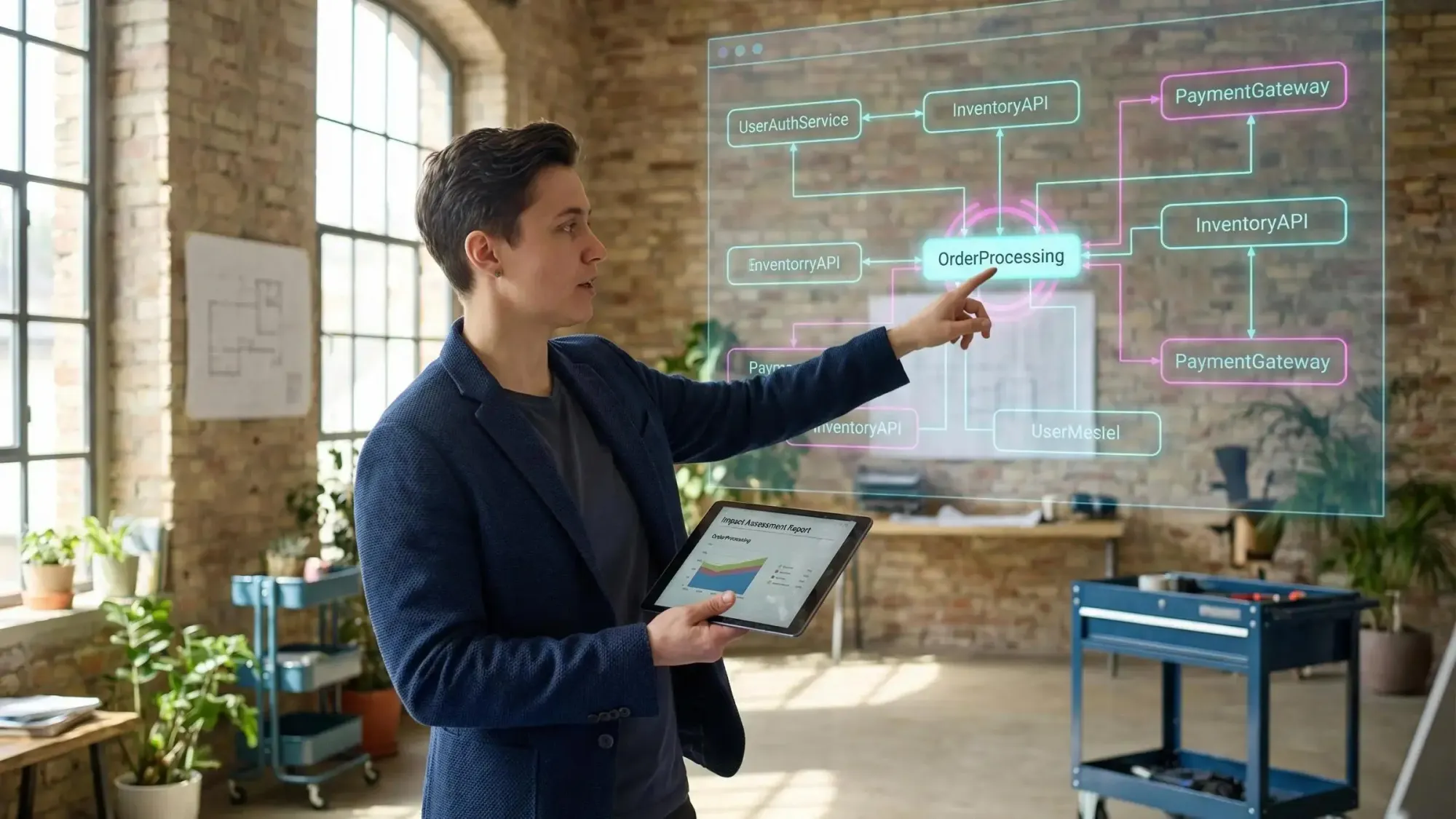
The missing layer is architectural visibility. That’s the bridge between fast AI generation and reliable review.
Why Diff-Only Review Misses the Bugs That Matter
A diff is useful. It’s just not enough.
A tiny change to a shared utility can break five production paths. A harmless rename can affect callers several hops away. A new function can be perfectly written and still never run because nothing actually wires it into a live entry point.
That’s where diff-only review falls over.
Older review approaches were basically smart linters over changed lines. Newer systems are better when they widen the frame to related files, contracts, and dependency paths. Even then, if they’re still anchored to “what changed” instead of “what this change touches,” they miss the bugs that matter.
The common misses are pretty consistent:
- breaking changes in shared functions or schemas
- duplicate logic added because the existing helper wasn’t found
- dead code that compiles but is never called
- hidden coupling between modules that makes refactors unsafe
This is the blunt version: if your review system cannot answer what depends on this, what calls this, and does this reach production, it is not set up to prevent bugs.
That’s why AI review can feel smart and still be unsafe. It sounds informed while guessing through partial visibility.
The Shift That Makes AI Review Actually Useful: Structural Context
The useful shift is giving the agent a map instead of asking it to wander.
Structural context is that map: functions, modules, dependencies, endpoints, cron jobs, entry points, and how they connect. Once that exists, the AI doesn’t have to infer architecture by opening random files and hoping it found the right ones.
The difference in practice is bigger than most people expect.
Without structure, an agent may spend 40K tokens poking around a repo to answer a basic question like “where is this formatter used?” With structural context, that same question can often be answered in closer to 2K tokens because the agent starts from relationships, not raw file search.
That changes the workflow:
- orientation in unfamiliar repos gets faster
- duplicate helpers show up earlier
- refactors get less risky
- PR review becomes more focused
This is infrastructure for AI tools, not another coding assistant.
One example is Pharaoh, which turns your repo into a queryable knowledge graph and exposes it to Claude, Cursor, Windsurf, and similar clients through MCP. After the initial mapping, those lookups are deterministic graph queries, so there’s no LLM cost per query. That matters more than it sounds. Once your repo gets large, repeated “go read the codebase again” is both expensive and sloppy.
How Knowledge-Graph-Based Review Prevents Bugs Before They Ship
Here’s the mechanism in plain language.
You parse the repository into a graph of functions, modules, dependencies, endpoints, and relationships. Then you let the developer or AI agent query that graph during coding and review.
That’s different from generic AI review in a few important ways.
First, deterministic parsing lowers hallucination risk. The system isn’t improvising the structure of your codebase from incomplete reads. It already has the structure.
Second, graph queries are a much better fit for transitive impact questions. “What breaks if we change this?” is a relationship problem, not a text summarization problem.
Third, you stop re-reading the entire repo every time you need one architectural answer.
The highest-value workflows tend to be:
Before risky edits
- blast radius analysis before refactoring a shared function
- dependency tracing before splitting or decoupling modules
- function search before adding new business logic
After implementation
- reachability checks for new handlers, services, and exports
- dead code detection after cleanup or migration
- spec gap checks when comparing what should exist versus what actually does
This kind of system is not a few things people often assume:
- not an IDE plugin by itself
- not a PR bot that automatically comments on every line
- not a testing tool
- not an LLM answer engine doing fresh reasoning on every query
It’s closer to architectural memory for your agents.
The Five Highest-Value Checks for Preventing Bugs
If you only add a few checks to your workflow, make them these. They cover most of the expensive mistakes small AI-first teams keep making.
- Blast radius analysis
Ask: what breaks if we change this function, file, or module?
Use it before renaming, deleting, or refactoring shared code.
This catches downstream callers and impacted endpoints before merge. Quietly, this is the one that saves the most pain. - Function search
Ask: does this logic already exist somewhere?
Use it before writing helpers, validators, wrappers, or formatters.
Duplicate business logic is one of the most common AI-generated messes in a growing repo. - Reachability checking
Ask: is this new function or handler connected to a production entry point?
Use it after implementing endpoints, background jobs, exports, or event handlers.
Exported code is not the same as live code. People forget that all the time. - Dependency tracing
Ask: how are these modules connected, and is there a circular path?
Use it before splitting services or extracting packages.
Refactors get dangerous when coupling is hidden two or three hops deep. - Dead code detection
Ask: what can we safely delete?
Use it during cleanup passes, migrations, and post-refactor pruning.
“Looks unused” is not a safe basis for deletion.
The point isn’t to review more. It’s to stop being surprised.
A Practical Review Workflow for Claude Code, Cursor, and Windsurf Users
This should fit how people already work, not add a giant process layer.
Before coding, map the structure of the codebase, inspect the target module, and search for related functions. If a date formatter already exists, your agent shouldn’t be inventing another one.
Before changing existing logic, run blast radius on the function or module. If the change crosses boundaries, trace dependencies too. This is the step most people skip when they’re moving fast, then regret later.
After implementation, check reachability for anything new. Verify you didn’t introduce duplicate logic. Then look for dead code left behind by the refactor.
During PR review, don’t anchor on diff size. Anchor on impact. A 12-line change to a shared auth utility deserves more scrutiny than a 300-line isolated component rewrite.
A simple flow might look like this:
1. Show module structure for billing/date utilities2. Search for existing date formatter functions3. Run blast radius on formatBillingDate before editing4. Trace dependencies between billing and reporting modules5. After changes, verify new formatter is reachable from production code6. Check whether old formatter paths are now dead codeHuman review gets better when the tool does the structural work first. Then the reviewer can spend attention on judgment, contracts, and product logic instead of archaeology.
What to Look for When Evaluating Tools
Most feature lists are noise. For bug prevention, the useful questions are narrower.
Look for depth of architectural context. Can the tool reason across modules, related files, and dependency paths? Can it detect breaking change risk, not just style or syntax issues? Does it work naturally with agent-driven workflows, or is it just another PR comment layer taped onto GitHub?
A few criteria matter more than the rest:
- cross-module and related-file analysis
- ability to answer impact and reachability questions
- false positive profile and review noise
- latency inside real GitHub and editor workflows
- support for Claude Code, Cursor, Windsurf, or MCP-based use
There’s also a practical tradeoff around PR comments. Some systems auto-publish comments directly to pull requests. Others keep a human approval step. For small teams already dealing with noisy review, the approval layer is usually healthier. Auto-comments sound efficient until your PR becomes a wall of low-confidence suggestions.
It helps to separate categories:
- diff-aware reviewers for PR-level issue spotting
- system-aware tools for dependency, reachability, and impact analysis
If you need an ai code review tool that prevents bugs, the second category matters more. That’s where Pharaoh fits for teams who want system-aware context instead of another comment bot.
Where Pharaoh Fits in a Modern Review Stack
We built Pharaoh to make existing AI coding tools smarter, not to replace them.
It maps TypeScript and Python repos with Tree-sitter, stores the structural relationships in a Neo4j knowledge graph, and exposes that graph through MCP to tools like Claude, Cursor, Windsurf, and GitHub-based workflows.
The value is pretty direct:
- codebase mapping for faster orientation
- function search to avoid duplicate implementations
- blast radius analysis before risky edits
- reachability checks after implementation
- dependency tracing during architecture work
- cross-repo auditing for monorepo or shared-package planning
The differentiator that matters here is simple: after the initial mapping, queries are deterministic graph lookups with zero LLM cost per query.
That doesn’t replace tests, human review, or your coding assistant. It gives those workflows a source of architectural truth they usually don’t have. If you’re using Claude Code, adding a codebase graph via MCP takes about two minutes. Pharaoh does this automatically via MCP at pharaoh.so.
Common Mistakes Teams Make When Adopting AI Review
Most mistakes come from using AI review as a style layer when the real problem is system risk.
We keep seeing the same ones:
- trusting PR comments as the main line of defense
- letting AI generate code before checking whether the logic already exists
- refactoring shared utilities without tracing downstream callers
- assuming exported code is live code
- buying tools based on comment volume instead of uncertainty reduction
- ignoring the difference between deterministic structural analysis and LLM guesswork
- skipping human approval when review noise is already a problem
A small team can absorb one or two of these mistakes for a while. Then one Friday refactor breaks a billing path or background job and suddenly everyone remembers why architectural context matters.
A Minimal Bug-Prevention Stack for Small AI-First Teams
You do not need a heavy platform rollout for this.
For solo founders and teams of 1 to 5, a sane stack has four layers:
- linting and tests for mechanical correctness
- AI review for PR-level issue spotting
- structural codebase intelligence for blast radius, reachability, and dependency analysis
- human review for logic and product judgment
For the broad linting and testing side, the open source AI Code Quality Framework is a useful reference.
The setup path should stay light:
- connect the repo
- expose structural context to your AI tool through MCP
- use a short pre-refactor and pre-merge checklist
The goal is not more process. It’s fewer avoidable surprises.
Actionable Checklist: Use This on Your Next PR Today
Copy this into your next PR description or agent prompt.
- Before coding:
- did we search for existing logic first?
- do we understand the module we’re changing?
- Before refactoring:
- what depends on this function, file, or module?
- are there affected endpoints, jobs, or cross-module callers?
- After coding:
- is the new code reachable from a production entry point?
- did we create duplicate logic?
- is there dead code left behind?
- Before merge:
- what is the highest-risk part of this change?
- what should a human reviewer inspect closely?
If you’re using Claude Code, adding codebase graph context through MCP takes only a couple of minutes. That one step tends to change the quality of review more than another round of generic PR comments.
Conclusion
A lot of bugs don’t come from carelessness. They come from missing architectural visibility.
The practical shift is straightforward: stop asking AI to guess its way through a repo. Give it deterministic structural context instead. Review changes based on impact, reachability, and dependency truth.
Try the checklist on your next refactor or PR. If you want that workflow automated through MCP, Pharaoh is one way to add that architectural layer to the AI tools you already use.