Check Blast Radius Before Refactoring for AI Agent-Ready Code

Most AI-native developers know you must check blast radius before refactoring, especially when solo or moving fast with agents that can’t see all your code’s connections.
We see how quickly duplicate logic and hidden breakages spiral out of control.
If you’ve felt this pain, you’re not alone. This guide shows you:
- When and how to check blast radius before refactoring to prevent cascading bugs
- How knowledge graphs unlock deterministic context for agent-driven code changes
- Why integrating blast-radius checks with your AI toolchain transforms reliability and review cycles
Why You Must Check Blast Radius Before Refactoring in the Era of AI Agents
You want to move fast. You want your AI agent to refactor or add features and ship twice as quickly, but there is a real cost if you ignore what breaks across the codebase. Using agents like Claude Code or Cursor, you’re not just battling obvious bugs—you’re fighting silent breakage, spread-out side effects, and lost velocity from duplication you never see coming.
Common pitfalls our users faced before mapping blast radius:
- Agents miss cross-module dependencies and break features in places developers don’t expect. A single update can quietly shatter far-flung endpoints.
- Without full blast radius analysis, changes produce hidden technical debt: duplicate code, brittle behaviors, and regressions that crawl through your codebase.
- Teams relying on autocomplete or IDE search miss indirect or transitive links, which are exactly the links tested in production.
- Smaller teams using agents face the highest risks. Quick bot edits sometimes unleash days’ worth of review hell.
Knowledge-graph approaches, especially our own, give you a living architecture model—so you know every file, service, or repo a change might hit, even if your AI agent can only “see” a single repo at once.
Empirical evidence tells the story—when developers deploy structured context, assessment time drops from months to days. Structured, context-first refactoring directly unlocks high-velocity upgrades, from multi-million line migrations to critical endpoint cleanup.
What Happens When You Skip Blast Radius Checks
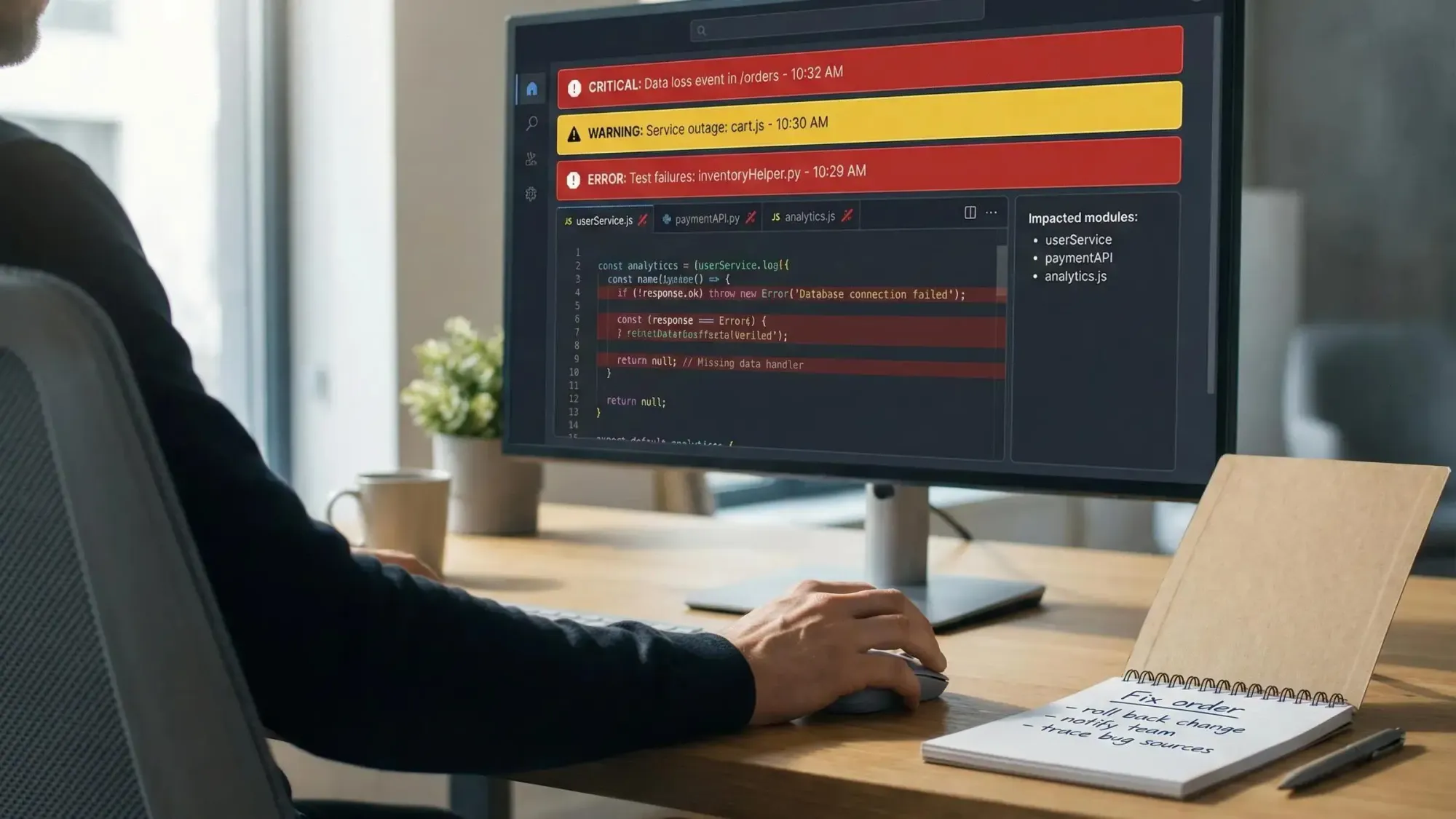
Let’s break down the chaos. When you skip blast radius checks, you give your agents the green light to act with only partial knowledge. You end up patching holes after the fact, firefighting rather than shipping confidently.
Real risks when you miss blast radius
- Updating a utility breaks dozens of downstream consumers—often those with shadow dependencies or undocumented links. Debugging eats days.
- AI-generated features often reproduce old logic. Lacking structural context, agents write new implementations for patterns they simply didn’t see.
- Entropy grows fast. You find yourself with repeated code, failing tests, and more complexity with every round of changes.
- With AI moving at machine speed, the scale of risk jumps. Silent bugs spread through your footprint, sometimes making it to production before you notice. Data loss events, endpoint outages, and root-cause headaches multiply.
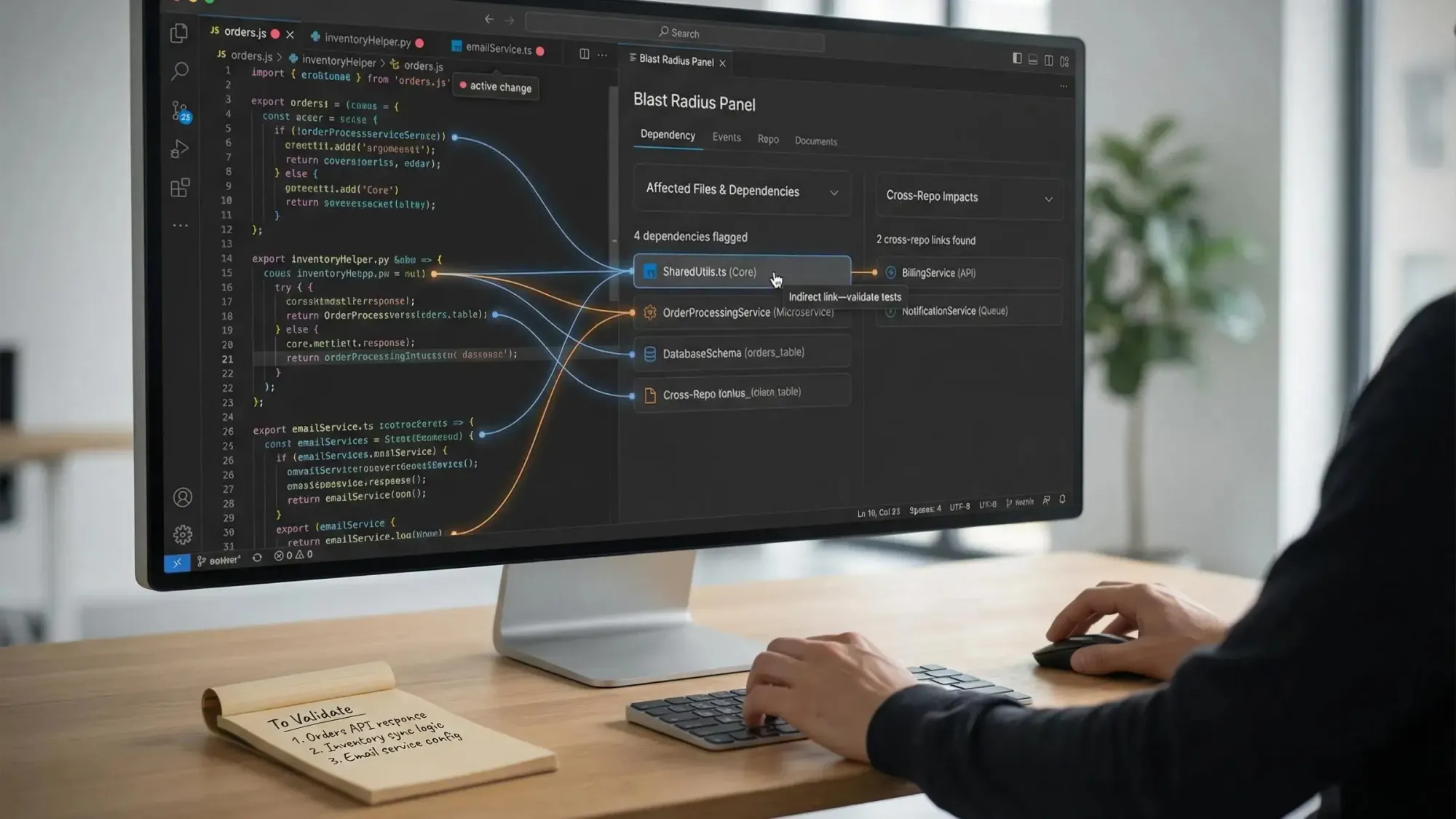
Blast radius reports give you a real list of files, tests, and endpoints likely to break so you can focus tests and fixes exactly where they matter.
Teams that run proper blast radius analysis cut time spent diagnosing issues by half. By pinpointing direct and transitive dependencies, you turn firefighting into focused, proactive triage.
How Blast Radius Analysis Works: From Manual Pain to Automated Precision
Understanding blast radius used to mean manual detective work: grepping, ad hoc static analysis, and tribal knowledge passed from one dev to another. That’s over. Modern, deterministic blast radius analysis is fast, precise, and integrates seamlessly with your AI assistant workflows.
How we revolutionize this process at Pharaoh
We automatically parse your TypeScript or Python code with Tree-sitter, extract modules, endpoints, env vars, and more, then store it all as a Neo4j graph. This means you can query function reachability, module consumers, and multi-repo dependencies instantly.
- Parse your entire codebase with Tree-sitter, producing a rich, machine-readable graph of structure and logic. No time wasted searching by hand.
- Store results in Neo4j so queries—like "who calls this function, even three hops out?"—are instant and broad. You see the true blast radius, not just straight-line dependencies.
- Enable agents to call “get_blast_radius” or similar methods before every major change. This makes automated, contextual awareness part of every refactor or new feature push, not an afterthought.
- Use Pharaoh’s agent-facing tools for instant, actionable blast radius maps, cutting through noise and reducing duplication, drift, and review pain.
All this gives you reproducible, zero-token-cost impact assessment—critical for AI-driven teams moving at speed.
What It Means to Make Your Codebase Agent-Ready
To operate at top speed, your codebase has to make sense to both humans and AI agents. Being agent-ready is a game-changer for solo founders and lean teams looking to reduce risk and boost output.
Key upgrades for agent-ready, blast-aware codebases
- Architectural knowledge is codified, not scattered through docs or Slack. Agents don’t guess—they query the structure.
- You surface which modules are tightly coupled, where hidden circular dependencies live, and reveal true reachability of endpoints—dead code stands out, test-only paths can be ignored.
- PRs and code reviews stop feeling like a slot machine. You see the gap between business specs and actual code, so bulletproof change is the new default.
- With Pharaoh, onboarding time drops, regression risks fall, and every change comes with structural intelligence built in—ready for any agent-driven workflow.
Agent-ready means both bots and people work with context, not in the dark.
When and How to Integrate Blast Radius Checks in Your AI Workflow
Blast radius is most valuable when built into every phase of your change pipeline, not tacked on at the end. You want status, impact, and risk, all surfaced automatically.
Essential moments to map blast radius for max ROI:
- Before any rename, delete, or major refactor. Get context before you cut.
- During pull request review. Show what breaks before a merge, not after.
- When launching new modules or features. Preempt conflicts and overlaps.
For agent-heavy flows, configure your agent to call blast radius queries before it proposes code. This minimizes hallucinated fixes and blocks accidental breakage. Our “get_codebase_map” and “get_module_context” tools give an up-to-date snapshot in seconds—no manual digging needed.
Automate safety with our PR Guard so every PR on GitHub receives blast radius tracking, structural diffs, and risk scoring. Tests and gated merges become focused, not guesswork. Blast radius awareness is the foundation for secure, scalable development with AI agents at the core.
Key Differences Between Legacy and AI-Native Refactoring
Legacy refactoring relies on memory, static search, and scattered experience. For most small teams today, this isn’t enough. AI-native refactoring raises the stakes. When you let agents drive change, context is everything.
Why AI-native needs explicit context
- Machines can’t improvise context. Agents repeat mistakes when they can’t access structured, up-to-date dependency maps. If you let them edit blind, they break contracts you never knew existed.
- Deterministic parsing and graph storage replace guesswork with certainty. You avoid duplication, broken call chains, and hidden regressions.
- AST-based refactoring is safe but limited in scope—great for syntax, not patterns. Higher-order changes need graph-driven analysis that reveals deep, real-world coupling.
Teams linking deterministic graphs to agent workflows see improved compile pass rates, faster cleanup, and pinpoint bug detection with fewer cycles.
When you cut manual context hand-offs, you move faster, ship cleaner code, and actually trust your agents to accelerate workflow rather than amplify mistakes.
Addressing Common Objections and Myths Around Blast Radius Checks
Every fast-moving developer hears objections about structured context. Some think “AI will figure it out”, others worry blast radius analysis is too slow or too much work.
Busting the big myths:
- Token limits cut agents off from full-repo context. No AI coding tool today reliably covers every relationship without extra structure.
- Knowledge graph parsing runs in minutes, not hours. Once built, queries are instant. No more wading through symbols or losing time to brittle regex search.
- Solo devs benefit just as much as teams. Most bugs come from transitive, not obvious, links—and objective, up-to-date lists cut code review time for single-person shops too.
- Deterministic graphs stop hallucinations. When agents work from explicit structure, they're less likely to generate false fixes or repeated code.
Blast radius checks aren’t just for large teams—they’re for anyone who wants fewer regressions and higher confidence with every commit.
You save hours, prevent most silent bugs, and find risk points before PR review ever starts.
Practical Steps to Adopt Blueprint-Driven Refactoring
Want to shift your workflow and lock in safer, smarter refactoring? Here’s how to put blueprint-driven tactics to work, fast.
Step-by-step plan for developers
- Install a knowledge graph platform like Pharaoh. We parse your GitHub repos and map modules, endpoints, and structure with Tree-sitter—no config needed.
- Connect your AI code tools (Claude Code, Cursor, Windsurf) to our MCP endpoints for seamless code context queries.
- Make blast radius reports mandatory before every refactor or major code review. Post diffs so reviewers see every affected file or consumer, not just what’s in the PR.
- Use our 13+ tools—like dead code detection, dependency tracing, or codebase mapping—to catch risks early. Don’t leave this to memory or chat.
- Start small: pick a utility or dashboard module, run a guided blast radius check, and expand across your codebase as confidence grows.
Track test coverage, blast radius report usage, and how many incidents you dodge. Keep every rollout traceable and staged for easy rollback if needed.
Blueprint-driven change means your team spends less time hunting bugs and more time building the next release.
With clear metrics, staged gates, and reproducible context, even solo founders unlock enterprise-grade safety from day one.
Frequently Asked Questions About Blast Radius and Agent-Safe Refactoring
Developers running AI-driven workflows always have tough questions about process and payoff. We hear these the most:
- Can I use blast radius analysis with TypeScript and Python mixed? Yes—Pharaoh’s pipeline parses both and builds one cross-language graph.
- What’s better about a knowledge graph approach? Deterministic relationships and multi-hop reachability mean agents work with proof, not hope. You see exactly what depends on any function, even when it spans modules.
- Is it fast? Yes. Once the knowledge graph loads, queries run in seconds. There's zero LLM token cost per analysis.
- How does this fit CI/CD pipelines? Tie PR Guard into your GitHub flow to post diffs, risk maps, and fail merges if blast radius confidence dips.
- What’s the real ROI for solo teams? Most gain a 50 to 90 percent reduction in triage, review, and incident hours in weeks, not months.
You can cut headaches and amplify AI power while maintaining safety and velocity.
Conclusion: Make Calm, Controlled Change the New Default
Ship faster by making every refactor a controlled, measured event. When you use Pharaoh’s knowledge graph to check blast radius before any code change, you eliminate guesswork.
Refactoring turns into a confident, low-risk process. Your AI agents get real context. Your team’s productivity—and peace of mind—soar.
Try Pharaoh’s free tier at pharaoh.so. See your codebase’s real blast radius before your next big (or small) change. Give your workflow the context it deserves.