Codebase Graph for AI Coding Agents Integration Guide

Too often, even the best AI coding agents struggle to understand your code’s true structure without a codebase graph for AI coding, leading to duplicated code, risky edits, and architectural blind spots.
We know how frustrating it is when context-aware automation just misses the mark.
This guide is here to help you achieve real clarity by showing how to:
- Integrate a codebase graph for AI coding with GitHub and leading agents
- Surface architectural relationships and dependency paths, not just keywords or files
- Enable safer, more systematic agent workflows for solo developers and small teams
Understand the Power of a Codebase Graph for AI Coding
A codebase graph isn’t just another toy for your AI tools. It’s the missing context that transforms weak, mistake-prone agent code into something you can ship with confidence. Structure-aware AI cuts wasted cycles and gives you deeper coverage on every workflow, especially when you’re moving fast with a small team.
Here’s why you want a codebase graph for AI coding, not another keyword search:
- Architectural context, not just content: AI with graph awareness can reason over your functions, modules, and dependencies. No more file-level hallucinations or duplicate helpers.
- Blast radius, mapped: A real graph means your agent can see all upstream and downstream effects instantly. Every edit, covered. No black boxes.
- No more accidental breakage: With a graph, the agent gets project-wide reachability and can plan safe bulk refactors or surface dead code with one query.
- Persistent, structured memory: Unlike “more context window” hacks or RAG blob searches, a graph bakes in your architecture. Agents pull only what they need, when they need, deterministically.
- Zero fuzzy matching risks: You get clarity, not guesswork. Graph paths for caller chains, function drift, or test coverage don’t mislead like semantically similar chunk retrieval.
The navigation here is actively different from simple search or retrieval. Memory shouldn’t be a mish-mash of snippets. Your agents need realtime answers, structured by the true shape of your repo.
Codebase graphs turn static files into a living map for your AI—so your agent stops guessing and starts proving.
The Shortcomings of Context Window Bloat and RAG
It’s tempting to think adding more tokens or dumping all your code into a search box will work. Here’s the reality check:
- Retrieval-Augmented Generation (RAG) sends back out-of-context chunks. The LLM is left to guess how to connect the dots, often missing critical chains.
- Expanding the context window only stacks more unrelated lines. LLMs remain stateless and error-prone.
- Changes across many files? Pure RAG misses the multi-hop dependencies, letting blind spots slip through.
- Flat blob memory gets out of date quickly. A graph can invalidate or update structure right when you change something.
Graph-native navigation lets your agents map blast radius, spot architectural anti-patterns, and cut duplication reliably. This is the missing link for solo developers and lean AI teams who run into these problems daily.

See How AI Agents Use the Codebase Graph in Daily Workflows
Linking your codebase structure to AI agents changes how you review, refactor, and audit code. Here’s how agents win when they use graph context.
- Safe, systematic refactoring: Agents can look up all callers, see every downstream use, and touch complex flows with confidence.
- Duplication detection: Identify identical or similar utilities across files, languages, or entire repos, fast. No more silent proliferation of helpers.
- Blast radius analysis: Run impact checks before edits. Your agents avoid surprise breakages.
- Code review turbocharged: Every pull request gets graph-level insights. AI checks the real dependency lines before adding its suggestions.
- Dead code surfaced: Automated reachability checks tag and propose removal of unreachable code.
Tools like Claude Code, Cursor, Windsurf, and any MCP-compliant agents plug into your graph and boost their IQ instantly.
Here’s how it looks in practice:
- The agent queries the graph for all callers of a function—across Python and TypeScript.
- It checks direct and transitive dependencies.
- It maps out test coverage before proposing edits.
- It only suggests changes that won’t cascade into regressions.
With Pharaoh, your agent can tap into this graph context before every major change, so you skip hotfixes and commit with confidence.
AI agents armed with codebase graph context go from making guesses to enabling proof-driven development.
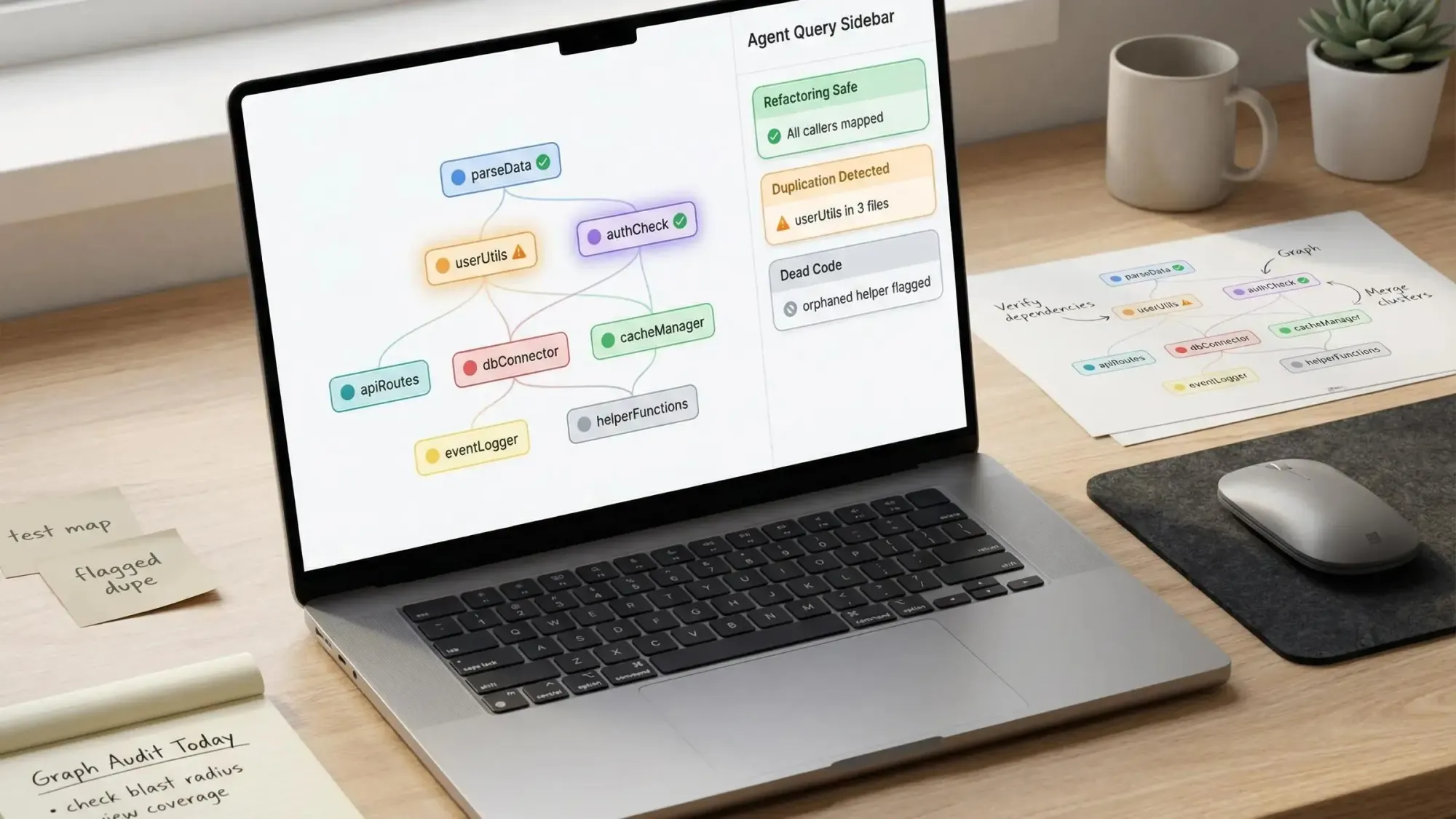
Build the Brain of Your Repository: From Source to Knowledge Graph
When you want high-fidelity source mapping, start by parsing your codebase into a graph. Parse fast. Get results that update as you ship code.
See How the Graph Gets Built
Parsing your repo means running Tree-sitter to extract functions, modules, APIs, call chains, and environment variables. This data gets mapped into a scalable graph database like Neo4j.
- Each node becomes a function, file, or API endpoint.
- Edges map calls, dependencies, imports, and more—all in a format that is ready for agents.
- Metadata like churn, complexity, and test coverage attach to nodes, helping you prioritize work and risk.
Pharaoh auto-parses TypeScript and Python projects, builds this graph deterministically, and surfaces insights in minutes from your GitHub repo. Everything’s mapped and queryable.
Anytime you change code, the graph updates. Short feedback loops, zero confusion.
When your codebase is a knowledge graph, every tool you use goes from static inspection to living knowledge.
Integrate AI Coding Agents with Your Codebase Graph
You want real context, not black-box guesses. Linking your AI agents to your codebase graph is the simplest way to get there. Here’s what the integration flow looks like.
- Install the integration of your choice.
- Connect your GitHub repo.
- Add your MCP endpoint to any agent that supports it (Claude Code, Cursor, Windsurf, GitHub Apps).
- Every time the agent acts, it silently asks the graph for blast radius, callers, references, and more.
You stay productive. Your agent acts smarter. No extra tokens. No tweaks needed.
A few tips for smooth setup:
- Use standardized JSON from your LSP (Pharaoh uses this approach with deterministic outputs).
- Authenticate endpoints and schedule regular graph updates triggered by commits.
- Leverage the Model Context Protocol (MCP) to ensure compatibility with multiple agents.
- Run pre-PR verification steps powered by graph queries.
This style of integration frees you from context window pain and gives every automated workflow first-class architectural awareness.
Unlock Advanced Capabilities: Go Beyond Simple Code Search
Graph-based analysis brings features that old-school tools just can’t touch. Move your team (or your solo workflow) from guessing to deterministic results.
Unmatched Features for Agent-Driven Work
- Blast radius risk scanning: One query maps out every function, endpoint, or service affected by a change. No more “oops, we broke X” moments.
- Cross-repo duplicate detection: Identify utility and API duplication across all your repos in seconds. Consolidate fast, scale cleanly.
- Production reachability maps: See which endpoints are actually exposed, traced, and used in production before you refactor or retire a service.
- Regression risk scoring: Attach churn, test history, complexity, and other metadata to prioritize which changes need the most caution—agent can do this automatically, every run.
- Map code to business intent: Use tools like Pharaoh’s get_codebase_map, get_blast_radius, and get_cross_repo_audit to instantly reveal high-value migration and consolidation opportunities.
The kicker: Once parsed, your agents query the graph without burning LLM tokens. Every workflow is fast, reliable, and tailored to your actual architecture.
Graph-powered agent workflows mean zero surprise outages, less duplicate code, and fast path clarity in any codebase.
Visualize and Explore Your Codebase Like a System Designer
When your repo becomes a codebase graph, system-level navigation gets easy. You step up from browsing lines and files to seeing every module, dependency, and service in clear, connected layers. This isn’t just nice to have. It’s the difference between working blind and working with foresight.
Every new contributor, contractor, or agent sees the same up-to-date graph—function relationships, calls, modules, exposed APIs, and even ownership. Planning, onboarding, and documentation move at warp speed.
- Instant onboarding maps: Give any new engineer (or yourself) a graph-driven view of what touches your most critical modules, who owns what, and where work flows bottleneck.
- Cross-language system clarity: TypeScript frontend calling a Python backend? Graphs map those connections, so no dependency gets hidden.
- Up-to-date diagrams: Pharaoh feeds architecture diagrams and README summaries straight from the live graph—saving you countless hours.
- Faster code reviews: Visual dependency trees mean reviewers see impact and context right away, not just raw diffs.
- Measurable ramp speed: Teams report faster onboarding and fewer architecture misunderstandings when using knowledge-graph-backed insights.
Great developers don’t guess—they zoom out, see the system, and deliver where it counts.
Overcome the Limits of Context Windows and RAG for AI Coding
Tired of memory limits and context window hacks? They’re duct tape, not real solutions. With a codebase graph for AI coding, your agents get purpose-built navigation—deep, reliable, and grounded in structure, not speculation.
What breaks with RAG and massive prompt context windows?
- Chained architectural questions get mangled. Retrieval splinters context.
- LLMs forget dependency chains. They confuse similarities with actual call paths.
- Flat memory systems can’t keep up with rapid code changes or refactors.
Graph navigation, in contrast, allows:
- Transitive dependency tracing in milliseconds.
- Consistent, zero-guess answers for blast radius or multi-hop dependencies.
- Real-world improvements in agent task accuracy, especially for architectural edits.
CodeCompass-style experiments proved this. Graph-powered tool invocation raises completion rates for complex, architecture-heavy moves, cuts errors, and gets you the answers you actually need.
The real win: faster fixes, fewer missed dependencies, and higher trust in every automated change.
Solve Real Problems for Solo Developers and Small AI Teams
If you’re building fast with AI, you need agent context that handles today’s actual problems.
Let’s go practical:
- Eliminate duplicate helpers: The graph surfaces clones across all projects. Ship once; reuse everywhere.
- No more broken callers: Remove a function, break a caller? Graphs give pre-merge warning every time.
- Find dead code, cleanly: Reachability checks tag the unreachable—so you run lighter, no bloat.
- Onboard in record time: Give new teammates a jumpstart—no more learning by spelunking random files.
- Safe, rapid rollouts: Blast radius scanning and pre-PR checks mean quick, risk-limited deployments.
Our solo founders and AI-native teams say it best: ramp time drops, incidents shrink, and the iteration loop closes. This is modern agent-powered development.
Compare Leading Tools and Make an Informed Choice
Not every codebase graph is created equal. The right tool matters when you connect it to your daily AI agent stack.
Here’s what matters:
- Determinism: JSON/LSP-backed outputs guard against unpredictable results. Pharaoh delivers this by default.
- Graph depth: Multi-language, multi-repo support. Pharaoh handles TS/Python cross-repo instantly.
- Integration surface: Does it plug into your agent? MCP support and ready-to-use endpoints are non-negotiable.
- Metadata-rich answers: Track churn, complexity, and code coverage as part of your graph.
- Zero-token local queries: Pharaoh’s approach means agents get deterministic, audited context for free, every pull.
You want a platform that plays well with your workflows and grows with you. Try a quick scan—Pharaoh’s free tier is made for proof-of-value right away.
Get Started: Integrate a Codebase Graph for AI Coding Today
Ready to step up from speculation to structured, agent-driven power? Fast start. No big setup.
- Install Pharaoh and connect your GitHub repo.
- Go live. Your first codebase graph spins up in minutes.
- See instant architectural insights—blast radius, cross-repo duplication, code maps.
- Connect agents like Claude Code, Cursor, Windsurf, and let them use the graph context for every edit or check.
No more low-confidence suggestions or missed edge cases. Documentation, architectural diagrams, and CI checks all sync from the same living graph.
Take the leap: connect your repo, activate the graph, give your agents architectural intelligence.
Conclusion: Operate from Structure, Not Speculation
Your daily reality shouldn’t be code chaos or blindfolded agents. Modern developer teams win by turning their repo into a living, queryable knowledge graph.
Pharaoh gives you that system-level perspective and raw, reliable context for every agent workflow.
Let’s transform the way you build. Bring order, insight, and speed to your agent-powered stack—starting now.