Smarter AI Agents with a Codebase Intelligence Platform

A codebase intelligence platform changes how your AI agents interact with your codebase by giving them structured, reliable context instead of leaving them to guess or duplicate work.
If you’ve ever felt frustrated by agents missing hidden dependencies or not grasping how your architecture fits together, you’re not alone.
We’ve put together a guide to help you:
- Connect your agents to a codebase intelligence platform for deeper, architecture-aware insights
- Use knowledge graphs to eliminate duplication, fragile refactors, and orphaned logic
- Power-up real GitHub repo workflows with deterministic, queryable context for solo developers and small teams
Why AI Agents Need a Codebase Intelligence Platform
Most solo devs and small founding teams using AI agents run into a core problem: smart tools lack real codebase understanding. You want agents that act like teammates, not risk factories. Yet, too often, you get PRs that duplicate work, break hidden dependencies, or scatter zombie code across your repo.
Here’s where structure and context shift everything:
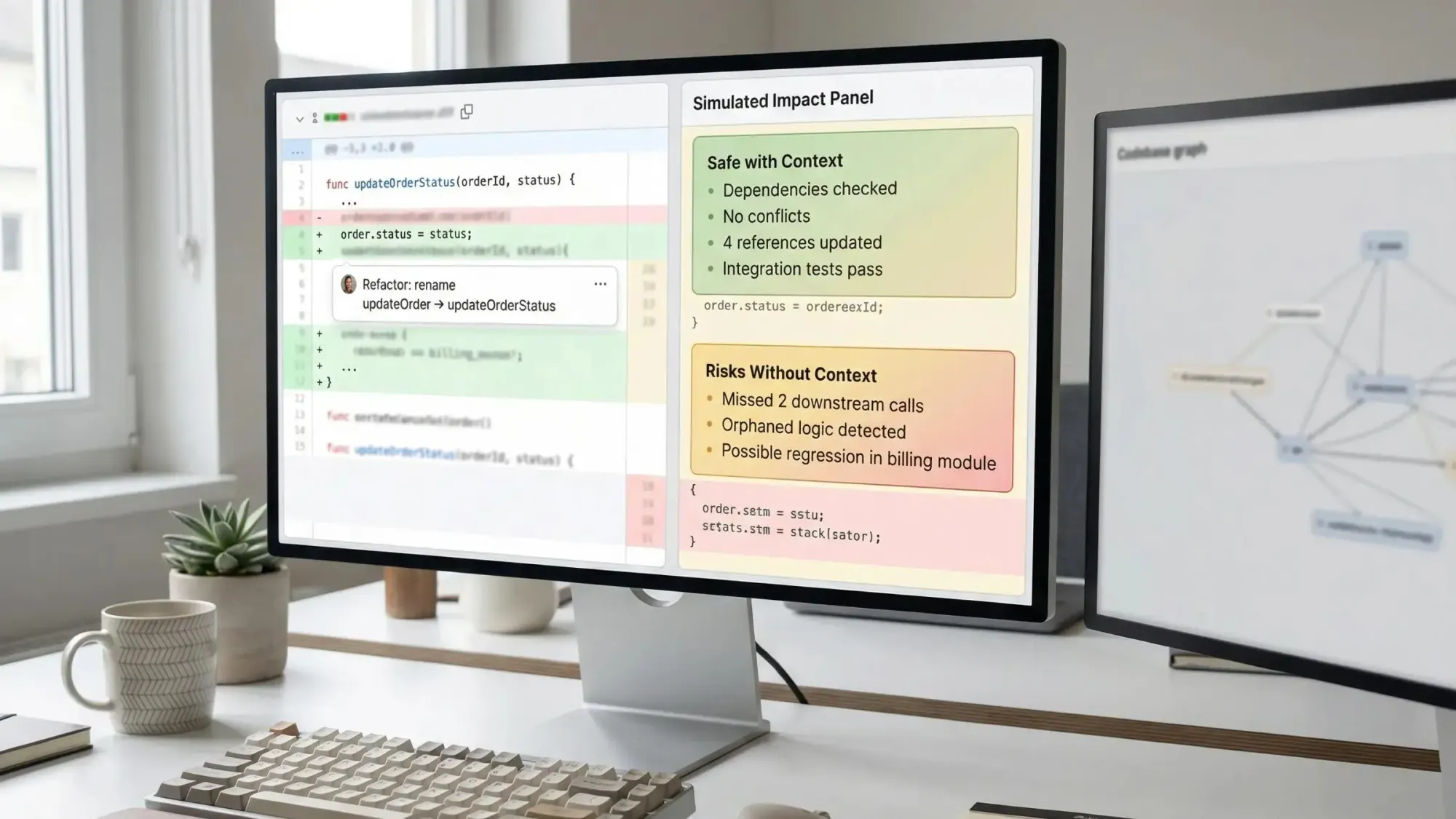
- Architectural awareness unlocks safe autopilot. Files mean nothing without connected meaning. Codebase intelligence brings structure: agents now see upstream and downstream impacts, not just local files.
- No more flying blind during changes. Agents equipped with deep, graph-based context avoid orphaning logic or missing critical links. This boosts reliability—and ship speed.
- Human-level mental models, but in seconds. Instead of fragile context windows, agents build on persistent, always-up-to-date maps of dependencies, functions, endpoints, and flows.
- Deterministic decisions, not guesses. Teams using deterministic codebase parsing see real results: faster refactors, lower roll-back rates, and a sharp drop in duplicated code.
- Token efficiency at scale. Querying a structured graph is cheap, deterministic, and measurable. Token-hungry LLM context windows are no longer a bottleneck.
- Smaller teams, bigger moves. With queryable code knowledge, solo devs and micro teams work at the speed of much larger orgs—no added cost or chaos.
Reliable software starts with good context. Great agent workflows demand real, queryable knowledge at every step.
How a Codebase Intelligence Platform Works for Agent-Driven Teams
A top-tier codebase intelligence platform flips the game for developers who want usable, live understanding—not just file dumps.
Architectural Blueprint, Not Just Search
Every useful insight comes from structure. That’s why platforms like Pharaoh handle:
- Automatic, deterministic parsing with Tree-sitter, giving zero hallucinations and 100 percent coverage for TypeScript and Python.
- Mapping your code’s DNA: modules, functions, dependencies, endpoints, jobs, and environment variables become graph nodes and edges.
- Realtime updates via GitHub Webhooks, so your codebase map always stays current. No more navigating stale or incomplete search indexes.
Native Tools and Integration
We believe querying the codebase graph should feel easy and instant. Pharaoh provides:
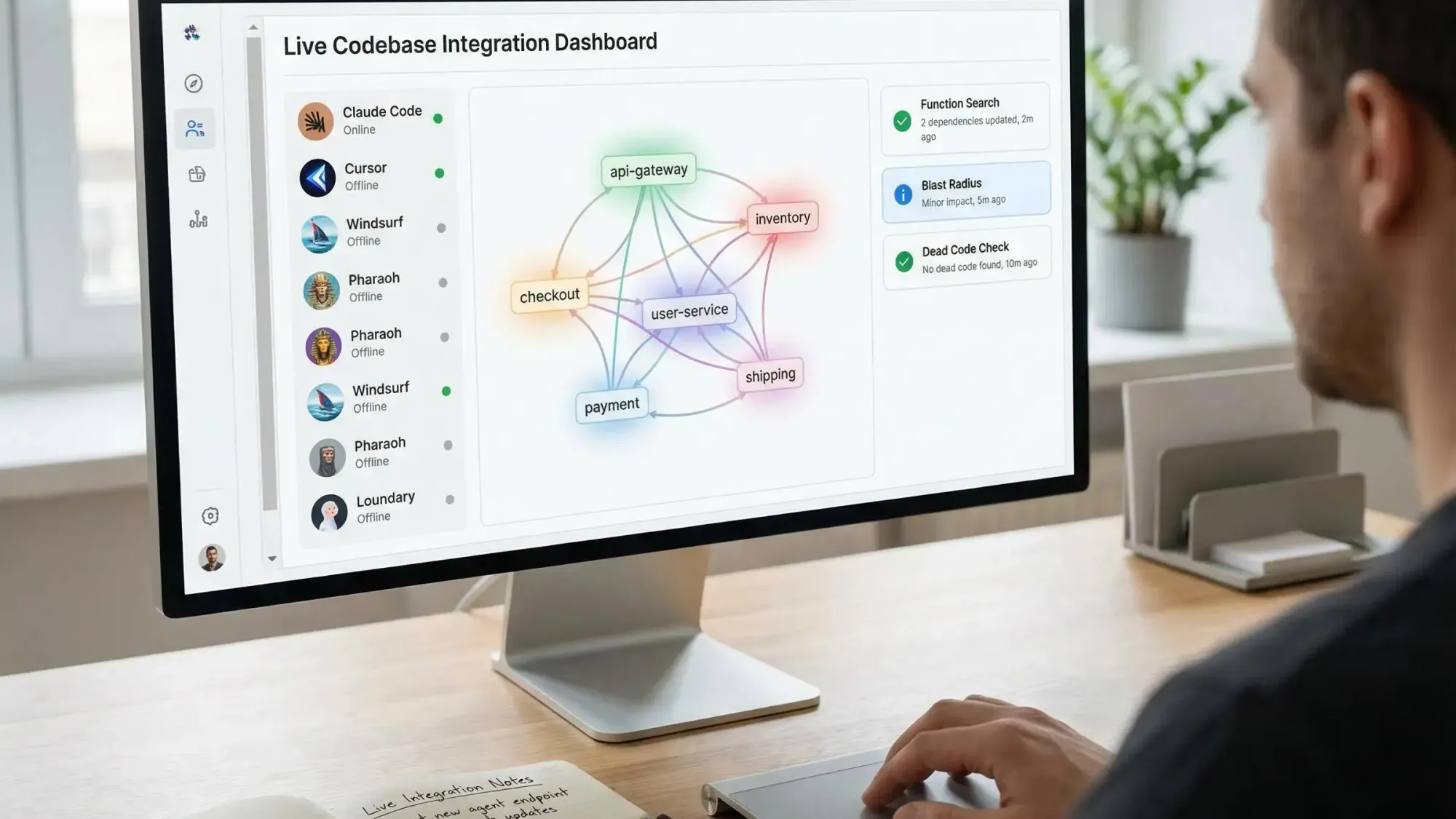
- 13+ native graph tools, including function search, blast radius, transitive dependency audits, dead code checks, and reachability—all accessible as simple API calls.
- Integration with Claude Code, Cursor, Windsurf, and any AI tool supporting Model Context Protocol (MCP). Plug in the endpoint, and your agent gets structure-aware superpowers right away.
Efficiency, Safety, and Live Context
Running a staged change, onboarding a new agent, or prepping a mass refactor takes seconds, not hours.
- No need to pipe entire code files into LLMs. Only load what matters: relevant fragments, targeted impact zones, and clear dependency lines.
- Graph queries return actionable, deterministic answers—no hallucination risks or context gaps.
- Real-world example: Pharaoh indexed a 50K-LOC TypeScript repo in minutes, updating the graph in real time as new code landed.
When agents act on architectural truth, not best guesses, you stop band-aiding bugs and start building without fear.
What Makes Knowledge Graphs the Backbone of Codebase Intelligence
Surface-level embeddings and raw file search can’t answer the questions that matter to AI-native teams. Knowledge graphs go deeper.
How Graphs Deliver Value
- Full relationship context: Not just what code “says,” but how everything connects.
- Transitive impact, clear and instant: Changes in one module? Instantly see ripple effects across the entire codebase. No more accidental breaks.
- Architectural change detection: New endpoints, deleted modules, cross-repo dependencies—all mapped and queryable as soon as they appear.
- Predictive workflows: Blast radius, reachability, and dead code checks become routine, not reactive.
When Graphs Beat Vectors
Graphs go far beyond simple similarity search.
- Vector DBs retrieve “what looks close.” Graphs answer “what depends on this” or “what breaks in production.”
- Complex queries like "show all production paths that transit through this function" are trivial for a knowledge graph, almost impossible via embedding search.
Graphs make every team member—human or AI—more proactive, precise, and confident.
Solving Real-World Blindspots in AI Coding with Structured Codebase Intelligence
Without the right foundation, even the best AI agent writes code that risks breaking your deadlines, your product, or your blueprint.
Blindspot Killers for Agent-Native Work
Here’s how codebase intelligence platforms like Pharaoh let you see—and fix—the hidden chaos:
- Function search to end duplication. Skip writing “yet another” utility; find where it already lives and avoid waste immediately.
- Blast radius mapping before PRs. Refactor without anxiety by tracing every transitive dependent—on the first try.
- Reachability checks spot orphan logic. Never deploy code if nothing calls it, or if deleting it breaks an endpoint. Catch the risk before it ships.
- Dead code discovery—safe deletions. Remove with confidence. Static and runtime signals work together for higher precision.
- Proactive dev flows. Move from firefighting to planned, structure-first changes. Teams using this approach report lower bug counts and better PR acceptance rates.
When agents anchor decisions with ground-truth structure, “move fast and fix later” becomes “move smart and get it right first.”
Integrating a Codebase Intelligence Platform into Your AI Workflow
Deploying a codebase intelligence platform isn’t a heavy lift. You can boost your workflow in a few focused steps.
- Sign up and connect your GitHub repo. Pharaoh auto-parses TypeScript and Python instantly.
- Get a live, queryable graph of your codebase. The index reflects all latest repo changes and updates automatically.
- Plug the MCP endpoint into your favorite AI tool. Claude Code, Cursor, Windsurf—now see structure-aware insights instead of static file reads.
- Run real queries: Search for dependencies on a module, map blast radius before PRs, or track reachability before you refactor.
Pharaoh makes this painless for solo founders and tiny teams—no extra infra, no extra cost per query, zero data retention beyond graph metadata.
- Native cloud hosting and CLI tools let you onboard in minutes, even on 50,000+ LOC projects.
- Deterministic queries cut token usage and runtime.
- MCP-ready agents gain instant context and safety checks.
Equip your agents with live architecture, not guesswork. Try Pharaoh or check our open-source code-quality framework for hands-on building.
Agent-Friendly Intelligence: From Fragile Hunches to Deterministic Ground Truth
Most AI agents operate on best guesses and what they can see in a token-constrained window. That’s fragile. We flip the process: context becomes cheap, precise, and always up-to-date.
We bring every agent query down to concrete, graph-powered answers. That means no more speculative vector lookups or “let’s hope the agent finds the right file this time.” Just reliable, rule-based insight.
- Agents move from searching to knowing. MCP-native agents skip multi-step discovery and access exactly what matters. Fewer rounds. Fewer tokens. More working code.
- Blast radius and reachability delivered by graph. When you ask, “If I change this function, what else breaks?”—you get a real answer, not just a guess from text similarity.
- Function and dependency relationships are always precise. Deterministic graph queries map every edge. Agents never hallucinate structure.
- Guardrails built in. Encode agent skills and security policies into workflows, so PRs follow your rules from day one.
- Faster, more trusted PRs. Teams see instant boosts in PR acceptance rates and review speed because every change comes with a mapped impact.
Context is power. Agents operating on architectural truth deliver reliable, production-ready results—no more “fingers crossed” shipping.
The Key Tools and Capabilities You Get with a Codebase Intelligence Platform
You need toolsets that match real workflows, not toy demos. With Pharaoh, you gain a whole toolkit built for safe, rapid, repeatable engineering.
Core Capabilities That Deliver
- Codebase mapping. Visualize your code structure in one go—from env vars to endpoints to cron jobs.
- Function search. Skip duplication. Find logic anywhere across all connected repos.
- Blast radius analysis. Change safely by mapping all dependents and impact zones, fast.
- Dead code detection. Hunt down zombie code with confidence by combining static and runtime signals.
- Reachability checking. Know exactly which endpoints run in prod and which functions are called.
- Vision gap analysis. Spot where your code and your product spec drift apart—before it bites you.
- Cross-repo audits. Detect duplication or consolidation opportunities that plain text search misses.
Tool-driven automation matters. Pair these with real workflows: onboarding, refactoring, planning, PR reviews, code cleanup. You move with speed and certainty—your agents work smarter, not just faster.
Unlocking real impact means building with confidence, not guesswork.
Limitations and Challenges in Codebase Intelligence Platforms
No platform is magic. You need clarity on what you’re getting and what’s still hard.
What’s Covered (and What Isn’t)
- Strong for TypeScript and Python repos; multi-language and dynamic code support are advancing but early.
- Operates at the architecture and syntax level—does not detect line-by-line static errors or runtime defects without extra instrumentation.
- Security built in: graphs use structural metadata only, never store raw source.
- Deterministic analysis cuts hallucination risk to zero, but dynamic evaluation (reflection, eval) needs hybrid static/runtime approaches.
Big monorepos get special handling using incremental “Merkle-tree” indexing and access control. For giant or multi-team footprints, planning and governance matter.
Dead code checks are sharpest when you can supply runtime signals (like tracing or coverage data). Without this, some unreachable logic may slip through.
Codebase intelligence is a foundation, not a final destination. Know your coverage, play to its strengths, and keep pushing the edge.
The Future of Agentic Engineering with Codebase Intelligence
Change is coming fast. Integrating codebase graphs into daily agent tasks will become standard for every high-performing team, solo dev, or founder building with AI.
Expect a future where:
- MCP and shared protocols become the norm—agents and tools all speak structure-first.
- Graph queries are reflexes, not afterthoughts. Teams see sharp token and cost drops as a side effect.
- Agents onboard, plan, and refactor using architectural blueprints, not unindexed files.
- Remediation, safety, and guardrails are just built in. PRs come with their own risk maps, and every push is safer than before.
Adoption playbooks already point to 40% daily agent use by day 60 for teams with deterministic, structure-first tooling.
Precision and speed aren’t luxuries—they’re the new baseline for shipping reliable, agent-driven code.
Conclusion: Turn Your Repo into an Agent-Ready Intelligence Platform
You want your agents—and your team—building on truth, not hope. Codebase intelligence is how you get reliability, speed, and clarity at every step.
Try Pharaoh for free and let your AI agents tap into a live, queryable map of your codebase.
Join the next generation of builders driving agent-powered development. If your agents aren’t querying real architecture, you’re just guessing. Time to upgrade.