Building a Codebase Knowledge Graph MCP for AI Agents

Every developer using agents knows the pain when AI misses architectural context or produces duplicate code—codebase knowledge graph mcp solutions are changing this.
You’re moving fast, your agents are working hard, but gaps in code understanding cost real time and safety.
We’ve created this guide to help you improve agent-driven development by covering:
- What a codebase knowledge graph mcp actually does for your AI coding tools
- How precomputed architectural graphs deliver concrete answers, not fuzzy guesses
- Practical workflow patterns to reduce regressions and ship confidently in small teams
Why Codebase Knowledge Graph MCPs Are Transforming Agentic Development
Change happens fast in AI-native codebases. If you're building with agents, you already know code search isn't enough. You want agents that see the full architecture and answer hard questions in real time.
Here’s what’s shifting the landscape:
- Structure on tap: Precomputed, deterministic graphs give your agents instant codebase context, not just file snippets. Our approach slashes time spent on side quests, so you focus on real development, not code archaeology.
- No more hallucination: A structured graph means every answer is repeatable, with zero chance of missing a key edge or generating a duplicate function.
- Slash token burn: One structured graph call does what twenty LLM file reads can't, driving down both compute cost and lag for every workflow.
- Strong context for all agents: Even smaller LLMs now produce robust changes, because architectural clarity comes built-in, not bolted on.
- Privacy at the core: Solutions like ours are built for local operation or tenant-isolated hosting, making privacy and regulatory needs easy for founders and enterprises.
- Real results for small teams: Solo developers or teams of two can move with the confidence of a much bigger group. Manual onboarding fades away, while regressions drop.
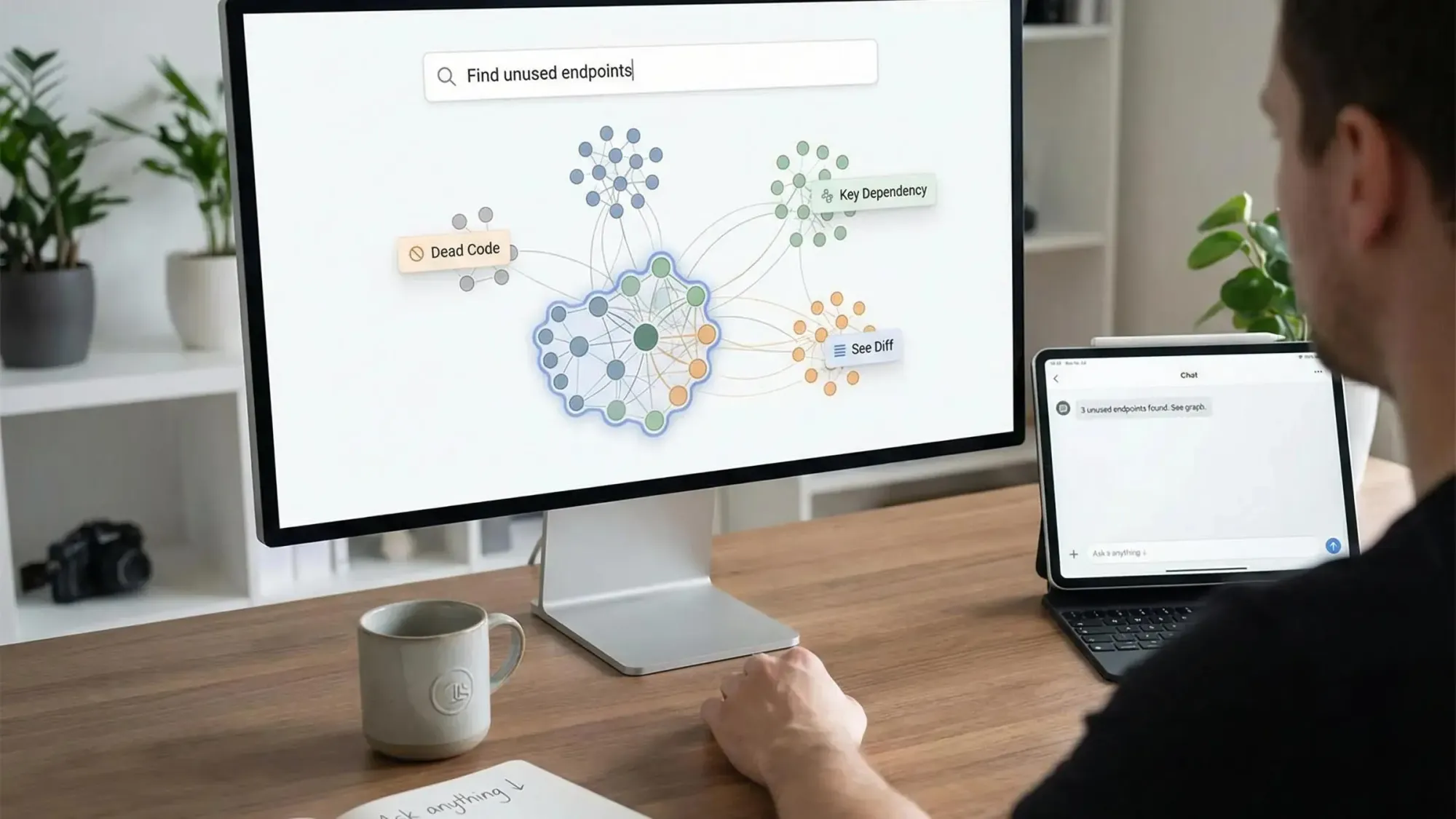
- Ask anything, get structure: When agents tap knowledge graphs using natural language, they discover dependencies, risks, and dead code that text search just can't find. Plain, high-level questions spark instant, precise answers—nothing gets lost in translation.
- Local, fast, and visible: With Docker or local-first options, you get instant graph builds, visual GUIs, or in-memory snapshots—all the transparency you need without cloud drift.
A codebase knowledge graph MCP means you finally have answers that agents (and humans) can trust.
What Is a Codebase Knowledge Graph MCP?
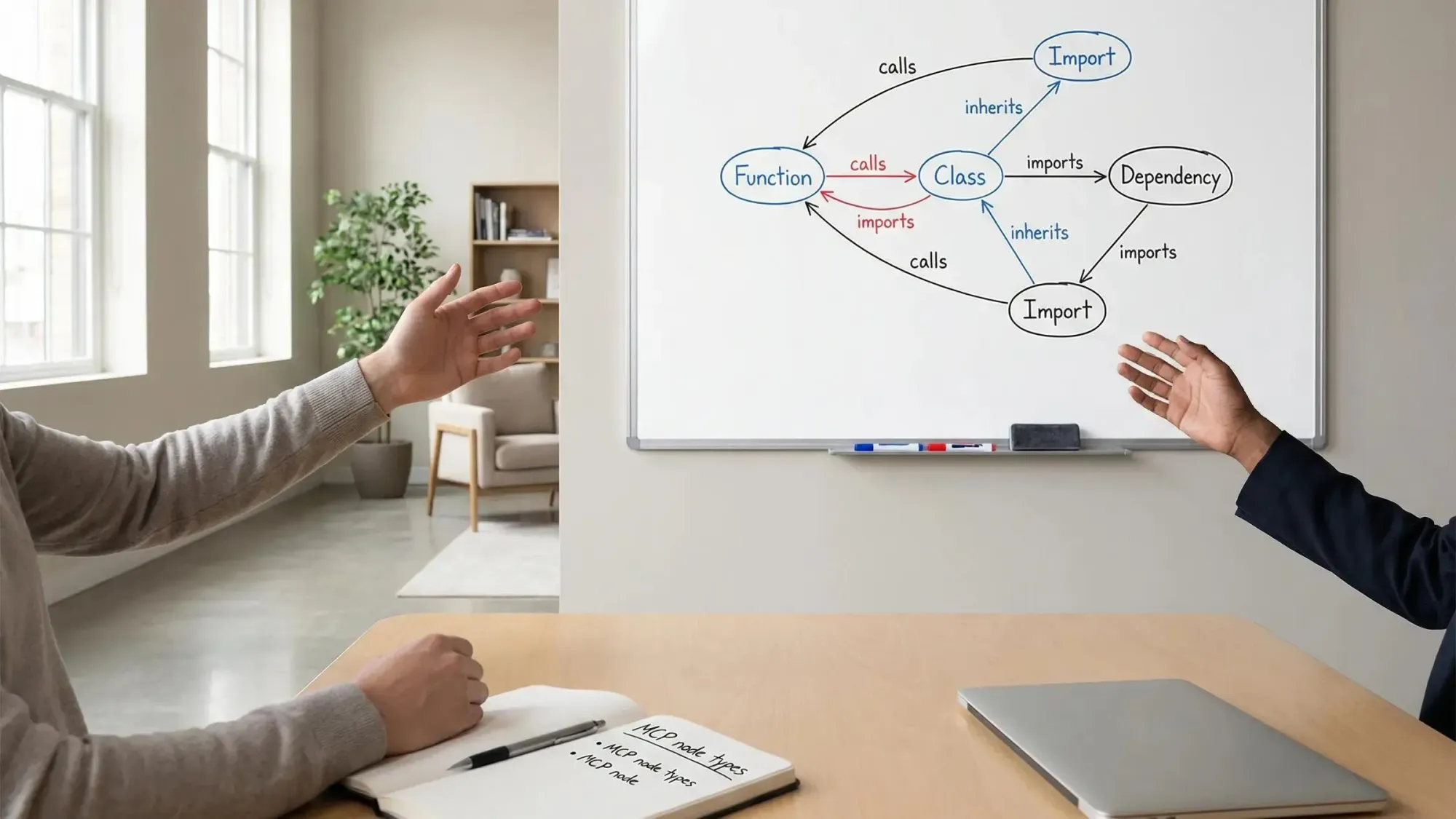
A codebase knowledge graph MCP transforms your codebase into a dynamic network of facts. It parses your source into nodes and edges—functions, classes, imports, dependencies—and exposes it as safe, queryable context for agents and developers.
Key Concepts Every Agentic Developer Should Know
- AST parsing: Pulls out code structure deterministically with tools like tree-sitter or language-native parsers.
- Graph schema: Typical relationships are clear: imports, function calls, inheritance, dependencies, endpoints, and more. Your architecture, mapped line by line.
- Semantics meet structure: Many graphs add embeddings to boost search and detect duplication, marrying context with meaning.
- Deterministic queries: Unlike standard LLM scraping, a knowledge graph MCP always gives the same answer for the same question. Reliable, reproducible, and actionable.
- Multi-language foundations: Starting with TypeScript and Python, and expanding rapidly by snapping in more tree-sitter languages. Never get boxed in.
One advantage: this beats code search or static analysis tools that only give raw pointers. A knowledge graph MCP surfaces true relationships and usage, not just code fragments.
For deeper dives, technical docs like modelcontextprotocol.io and examples like Pharaoh show what it looks like in practice. You can see explicit mapping of entrypoints, functions, exports, and even environment variables, giving every agent a reliable architectural lens.
How Does a Codebase Knowledge Graph MCP Work?
Every modern repo can run smarter with a knowledge graph MCP. Here’s how the process unfolds from first connection to active, queryable graph.
From Repo to Graph: The Developer’s Journey
- Integration: Plug in your GitHub repo using a simple App, CLI, or Docker. This will trigger the first full parse.
- Parsing: AST tools like tree-sitter extract code structure. Symbol graphs are created for every key entity.
- Storage: All nodes and edges go into a high-speed graph database like Neo4j. Now relationships, dependencies, and edges can be traced instantly.
- Continuous update: Webhooks keep your graph updated as you ship new code. No manual rebuilds after each push.
- Endpoints exposed: The MCP server exposes queryable REST endpoints for agents, editors, and tools.
- Security by design: Only structural metadata and embeddings are stored, not your raw code. Tenant isolation keeps each org’s context safe.
Supported languages start with TypeScript and Python, with fast expansion possible. You can see the graph in action using CLI commands or GUI visualization, confirming your codebase topology before you deploy major changes.
Every developer gets surgical-level insight without heavy setup: functions, imports, blast radius, risk—mapped and ready to use.
What Problems Do Codebase Knowledge Graph MCPs Actually Solve?
Stop chasing bugs caused by hidden dependencies or duplicate code. With a codebase knowledge graph MCP, every team member and agent sees the whole picture—right when they need it.
The core developer pain points we help you fix:
- Blast radius on tap: One graph query lists every downstream impact. Prevents broken deploys before they start.
- Dead code and orphans: Detect and clean out unused functions, endpoints, or files. Reclaim repo clarity.
- No more risky refactors: Know the exact list of affected symbols before you touch a utility or service.
- Token and time savings: Skip endless file scraping. One structured context drop replaces dozens of scattered LLM lookups.
- Root-cause clarity: When changes break things, track the full execution flow, not just direct callers.
Want proof? Solo devs often miss tens of downstream callers on a quick update. A knowledge graph MCP like ours gives instant depth, grouping results by risk, confidence, and reach. Reviewers see potential fallout—grouped by what will break, might break, or just needs review.
How Do AI Agents Interface With a Codebase Knowledge Graph MCP?
Agents demand context, and now they get it in one hit. Here’s how the interface looks in real AI-first workflows.
The Agent Workflow: Deterministic Queries for Superior Results
- MCP endpoints: Tools like Claude Code, Cursor, and Windsurf connect directly to MCP servers. Agents send intent-driven queries and receive structured graph responses, instead of scraping files.
- Get more, send less: Agents pull 2,000 tokens of deep architecture, not 40,000 tokens of noisy file chunks.
- Example calls:
get_blast_radiusbefore a refactor,search_functionsbefore new code, orcheck_reachabilityafter a merge. - Precomputed power: Agents reason over a solved graph, so each edit or suggestion is traceable, reviewable, and safe.
This gives your agents an edge: they can ask NL questions, map them to graph queries, and deliver real architectural results. Less hallucination, more precision.
Agents become true teammates when they work with real architectural intelligence, not just react to isolated files.
What Key Capabilities Should You Expect From a Knowledge Graph MCP?
Take control of your codebase. When you use a codebase knowledge graph MCP, you unlock practical superpowers—out of the box.
Essential Tools That Change the Game
- Repo mapping: Get a living map of functions, modules, environment variables, cron jobs, and more.
- Function/duplication search: Instantly search and group similar functions. See where bloat lives.
- Blast radius: Map change impact by depth and risk. Get grouped, execution-aware reports every time.
- Dead code detection: Identify unused code and orphaned endpoints fast.
- Reachability analysis: Know which entrypoints really hit a function or service.
- Spec vs. implementation checks: Find missing coverage or divergence with NL-driven gap analysis.
- Cross-repo audits: Track dependencies and duplication across your whole org.
Get deterministic context with each call, never pay a per-query token fee, and see results backed by graph evidence. When you work with a system like Pharaoh, you access 13 battle-tested tools in this space, each proven across live agent workflows.
Building vs. Buying: Open Source, Cloud, and Vendor Options
Making the call: Build your own or spin up a proven stack? A solid knowledge graph MCP should fit your team’s privacy, language, and scale needs.
We built Pharaoh to give solo founders and small AI teams the edge—without forcing you to wrestle with open source hygiene, self-hosted Neo4j, or slow incremental refresh. Our stack parses TypeScript and Python day one, builds tenant-isolated graphs, and powers agent workflows using the MCP protocol, with 13 fully equipped tools from blast radius to reachability.
What to Look for in a Robust Solution
- Incremental graph refresh: Essential for real-world teams shipping daily. The graph must update as you code, not lag behind.
- Multi-language parsing: Start with TS/Python. Fast expansion via tree-sitter or AST modules for Java, Go, and more.
- Managed privacy: Tenant isolation, local-first options, and private graph storage matter at scale.
- Ready-to-use tooling: Prebuilt integration with agent tools like Claude Code, Cursor, and GitHub Apps. This saves you days per sprint, not just a few minutes.
- Flexibility in deployment: Support for GitHub App, CLI, binary, or Docker so you can match the stack to your workflow and compliance needs.
You decide if you want operational overhead or proven speed. Pharaoh gives you both local and hosted options, with battle-tested performance and zero hype. For teams that don’t want risk or drift, it’s the practical path to agent-first development.
How to Integrate a Codebase Knowledge Graph MCP Into Your Workflow
You want to move the needle without headaches. Integrating a codebase knowledge graph MCP is straightforward—and built for the way agent-driven teams work.
It all starts with connecting your repo, kicking off auto-parsing, and plugging the MCP endpoint into the agents you use every day.
Quick-Start Integration Steps
- Install and connect: Use our GitHub App for rapid, secure repo connection. Or spin up locally via CLI or Docker if you need privacy or control.
- Auto-parse everything: The system runs a full parse and mapping pass with tree-sitter. No manual setup or config required. Key nodes (functions, endpoints, exports, env vars) appear as soon as processing finishes.
- Webhooks keep context fresh: Each push triggers a lightweight incremental graph rebuild. “Stale” context? Not here.
- Plug agents into the MCP: Claude Code, Cursor, and Windsurf integrate with one JSON config. You point them at your MCP endpoint—now every tool call gets contextual power.
Need help fast?
- Visit pharaoh.so for detailed guides.
- Access open frameworks at github.com/0xUXDesign/ai-code-quality-framework.
- Drop an
AGENTS.mdin your repo root. This file tells agents where things live, how to handle commands, and what hygiene to follow. - Explicit governance: Set clear boundaries for what agents can run, which commands need human approval, and where to route file edits.
Modern agent workflows thrive on fast starts, real context, and guardrails that make automation safer.
When and Why Should Founders and AI Teams Use a Knowledge Graph MCP?
You don’t want to gamble with your codebase. When you’re scaling fast or working as a small team, you can’t afford silent breakage or hidden duplication. Here’s when a codebase knowledge graph MCP delivers the biggest return.
- You’re dealing with rapid repo growth and need to keep agents (and new humans) on the same page.
- You’ve seen regressions from AI tools missing deep dependencies or editing in the dark.
- You want to stop wasting tokens and time on file-by-file scraping or bug-hunting missions.
- You need proof before merging: Run pre-merge blast-radius checks or root-cause diagnostics straight from the graph.
Teams using graph-driven workflows see these results:
- Higher agent confidence and fewer rollbacks.
- Faster onboarding for new teammates or agents—no more architecture guesswork.
- Real, measurable reduction in post-merge defects and CI failures.
The codebase knowledge graph MCP is your confidence booster: making agent collaboration safer, faster, and more predictable.
What Makes a Codebase Knowledge Graph MCP Different From Search, Static Analysis, or LSP?
Not all tools give you actionable architecture. Static analyzers catch bugs. LSPs power autocomplete. Basic search finds snippets. Only a knowledge graph MCP understands everything your agents want to ask.
Comparing Contextual Power
- Code search: Finds files, but never maps five layers deep or explains indirect risk.
- Static analysis: Spots line-level bugs but misses how symbols connect across the repo.
- LSP: Great for navigation, but can’t surface blast radius or cross-repo relationships at scale.
- Knowledge Graph MCP: Answers “what breaks if I edit this?” in one call. Visualizes multi-hop dependencies and real architectural links. Zero hallucination, grouped by execution or risk.
The result? Your agents operate with blueprints, not blurry maps. You stop sweating about costly blind spots or undetected duplication.
Structured graph context isn’t just nice—it’s now critical for agent-native teams to deliver value safely.
Advanced Use Cases and Patterns for Agent-Driven Teams
Once your knowledge graph MCP is live, you can unlock new automation flows and collaboration strategies. Small teams gain leverage that used to require whole code quality squads.
- Parallel agent orchestration: Split onboarding, refactoring, and cleanup among multiple agent “roles.” Each pulls from the graph, works in harmony, and avoids duplication.
- Automated PR guardrails: Insert pre-merge blast radius or impact queries into CI/CD. High-confidence risk? Flag it for review.
- Cross-repo audits on demand: Find duplicated logic or unsafe coupling before big migrations.
- Vision gap checks: Match AGENTS.md and specs to actual implementation. Get lists of missing pieces or drifted intent.
- Custom domain extensions: Add your own nodes (design tokens, custom clients) and make agents smarter about your architecture.
These advanced patterns let you operate like a team twice your size—without losing sleep or control.
Frequently Asked Questions About Codebase Knowledge Graph MCPs
Every founder has questions before letting new infra touch their code. We’ve heard them all.
How private is the data?
Our system stores only metadata and embeddings, never raw code. You can run everything locally or use our tenant-isolated hosted service.
Which languages are supported?
Out of the box: TypeScript and Python. Expanding via tree-sitter to Java, Go, C++ and more. You’re never locked in.
Does it slow down big repos?
Incremental updates and fast querying keep latency low—even as graph size grows.
What if agents return stale info?
Check webhook logs and MCP integration. The graph updates automatically, but manual refresh is just a CLI away.
Setup time?
Minutes for basic integration. Production hardening and CI hooks scale with your workflow.
Security, scale, and language support shouldn’t hold you back from using smarter tools.
Future Directions and Trends in Codebase Knowledge Graph MCPs
The edge keeps moving—fast. Here’s what’s next for codebase knowledge graph MCPs.
- Language expansion with more tree-sitter integration so you cover every repo, not just one stack.
- Wider MCP agent ecosystem: Expect plugins for more tools, more editors, more specialized agents.
- Org-wide audit and compliance: Multi-tenant graphs, deeper audit trails, targeted regulatory exports.
- Smarter memory and drift handling: MCPs will soon track code drift and help agents spot misalignments or outdated knowledge.
- Team metrics and dashboards: Leaders get visibility on code health, fan-in/out, and change trends without extra tooling.
You can bet that as codebases grow more interconnected, knowledge graph MCPs will shift from optional to operational baseline for the best teams.
Conclusion: Unlock a Smarter Agent Workflow With Codebase Knowledge Graph MCPs
A codebase knowledge graph MCP puts you in control. Ship faster, with fewer mistakes. Empower your agents to work with architectural intelligence—even as your codebase evolves. Teams using Pharaoh have turned their code into living, queryable blueprints for every agent and developer. Start for free at pharaoh.so and watch your agent workflow become safer, sharper, and far more productive.