Hidden Code Dependencies That AI Coding Tools Miss

AI tools miss hidden code dependencies when the relationship is not an import, a symbol reference, or a file in the current repo. You rename a field, the patch passes, and a worker or partner consumer breaks three days later.
For multi-module teams using Claude Code, Cursor, or Codex, safe changes start with blast radius—not the diff. We’ve learned that local tests prove less than you think when runtime wiring is elsewhere.
Before accepting the patch, check:
- Event payload consumers outside the producing service
- Feature-flag branches absent from default test runs
- Generated clients whose real source is a schema, not the file changed
Ship the change knowing what it touches.
The Failure Pattern Most Teams Recognize
You ask Claude Code, Cursor, or Codex to rename a field, update a shared helper, or bump a package. The patch looks tidy. Tests pass. Two days later, a worker crashes, a mobile screen starts dropping data, or a background job quietly stops writing records.
That feeling is familiar because the hard part was never typing the edit. The hard part was dependency discovery.
Experienced engineers pause before they touch shared code. We ask a different set of questions:
- What depends on this?
- What breaks if this changes?
- Who owns those downstream consumers?
- How do we validate this without learning in production?
That's the real tension with AI assisted coding. You get speed fast. In a multi module or multi repo system, speed without relationship awareness feels cheap. The patch may be correct inside the file and still wrong inside the system.
This article is a failure mode catalog. Not another vague "be careful with AI" piece. We’re going to look at the hidden code dependencies that cause late regressions, why current assistants miss them, and how to check for them before you accept the patch.
What Hidden Code Dependencies Actually Are
Hidden code dependencies are relationships that change behavior or blast radius but don't show up as a clean import or obvious call site in your editor.
The contrast matters.
- Explicit dependency: direct import, visible function call, declared interface use
- Hidden dependency: runtime loading, generated clients, config keys, event consumers, feature gated paths, cross repo consumers, code only reachable through startup wiring
Humans can stop and ask architectural questions. AI tools usually act on whatever repo slice they can retrieve and fit into context. That's why hidden code dependencies create more trouble in AI workflows than manual ones.
There's also a subtle distinction that gets missed all the time:
Code that looks like the thing you're changing is not the same as code that breaks when the thing changes.
Search finds resemblance. Safe change management needs reachability and downstream coupling.
A few terms matter here:
- Blast radius: everything affected if this contract or behavior changes
- Reachability: whether code is actually exercised in production, not just present
- Dead code: code that looks alive because tests touch it, but production doesn't
- Downstream coupling: consumers that depend on your output, often outside your repo or team
If your assistant can't answer those questions, it can still write a pretty patch. Pretty patches break systems too.
Why AI Coding Tools Miss Them
Most coding assistants are good inside a context window and weak outside it. That's not a personality flaw in the model. It's a visibility problem.
Search and symbol indexes are useful. They find names, definitions, direct callers. They do a decent job on file local edits. They are much worse at runtime edges, transitive dependencies, generated artifacts, and external consumers.
The usual pattern looks like this:
- The assistant updates the file you have open
- It catches a few obvious call sites
- It stops where the textual evidence stops
That gap is measurable. In one benchmark on rename and refactor tasks, standard text search found 3 percent of affected files. A relationship map found 65 percent. On dependency upgrade repair tasks, the best agent setup solved 104 out of 203 real world tasks. That's barely over half.
Those numbers line up with what most teams already feel in practice. The model isn't careless. It just can't reason from relationships it can't see.
Better prompts help less than people want to believe. If the system map is missing, prompt polish won't save you.
| Benchmark | Approach | Outcome |
|---|---|---|
| Rename and refactor tasks | Standard text search | 3% of affected files found |
| Rename and refactor tasks | Relationship map | 65% of affected files found |
| Dependency-upgrade repair tasks | Best completed agent configuration | 104 of 203 tasks solved (51.2%) |
Dynamic Imports and Runtime Module Loading
This is one of the oldest traps in the book. The dependency exists only at runtime, so local retrieval often misses it.
Common patterns include:
import()with computed paths- variable based
require - plugin registries
- filesystem based route or task loading
- convention driven discovery in frameworks
A tiny example:
// registry.ts
export const handlers = {
  refund: "refundHandler"
}

// loader.ts
const mod = await import(`./handlers/${handlers[job.type]}.ts`)
await mod.run(job)
Now an assistant renames run to execute or renames the file export in refundHandler.ts. The patch can pass local checks if nothing imports it directly. The failure shows up later when that job type finally runs.
Why this gets missed is pretty simple:
- there is no obvious import edge
- filenames or registry keys matter more than symbol references
- the real caller is a loader, not another function
If you suspect this pattern, slow down and check the runtime wiring:
- search for
import(,require(with variables, registries, autoloaders, filesystem walkers - inspect route manifests, plugin lists, startup loaders
- compare what the runtime includes against what direct imports suggest
- ask whether the changed module is discovered by convention rather than imported directly
This is one of those cases where the code lies by omission. Static references look quiet. Production isn't.

Queues, Events, and Asynchronous Consumers
Async systems hide some of the most expensive dependency discovery failures because producers and consumers rarely sit together. Sometimes they don't even sit in the same repo.
A producer emits an event:
{ "user_id": "42", "plan": "pro" }The assistant updates the producer to emit userId instead. The API still compiles. Direct tests still pass. Three hours later a worker fails to deserialize the message, a BI pipeline drops the row, or a partner webhook parser starts rejecting payloads.
No import chain connects those systems. That's the problem.
Watch for these patterns:
- message queues
- event buses
- outbox tables
- background jobs
- webhook consumers
- scheduled batch pipelines
AI coding risks go up here because the assistant often updates the producer and whatever tests live nearby, but misses every downstream parser. Async consumers are frequently outside the current repo, outside the current session, or both.
The checks are operational, not theoretical:
- list the topics, queues, event names, and payload schemas touched by the change
- trace both serialization and deserialization points
- inspect dead letter queues and replay fixtures
- check for versioned events and compatibility windows
- ask whether mobile, partner, analytics, or data jobs consume the same payload
If you only validate the producer, you haven't validated the change. You've validated your optimism.
Feature Flags and Runtime Branches
Feature flags distort your view of reachability. So do tenant rules, rollout percentages, and environment checks.
A branch that looks dead may be live for enterprise tenants. A branch that looks live may never run under current defaults. That fools humans and assistants equally, but assistants are more likely to accept the visible path as the whole path.
A common failure looks like this: the AI refactors a checkout flow that is only enabled for a subset of customers. Local tests run under default flags. Everything looks fine. Production takes a different branch.
Stale flags make this worse. They aren't just cleanup debt. They make blast radius analysis unreliable.
When a change touches a flagged area, check the flag itself, not just the code under it:
- enumerate flag reads and the modules gated by each flag
- test both enabled and disabled states
- inspect targeting rules and defaults
- check stale flag cleanup status
- identify environment and customer tier conditions around the path
A lot of "surprise" regressions are really flag blindness. The risky code was always there. Your local run just never took that turn.
Implicit Configuration, Environment Variables, and Service Locators
Some dependencies aren't expressed as code relationships at all. They're expressed through setup, container registration, environment variables, decorators, YAML, and startup order.
That's where systems get slippery.
A service locator is the sharpest example. A controller resolves a service from a shared container. The constructor doesn't declare it. The dependency is implicit. The assistant changes registration or constructor expectations, the app compiles, and a runtime path fails because registration happened in the wrong order or not at all.
The ugly part is temporal coupling. The app works only if something else was wired first.
Watch for these dependency sources:
- environment variables
- JSON or YAML config keys
- DI containers and service locators
- annotations and decorators
- registration maps and startup wiring
Practical checks help more than abstract warnings:
- trace where env vars are read and what defaults do
- compare container registrations against resolutions
- inspect startup code and composition roots
- validate config schemas across environments
- look for fallback behavior that hides missing wiring until production
A plain rule has saved us a lot of trouble: the more dependencies you express through constructors, schemas, and explicit wiring, the easier they are for humans and tools to reason about.
Implicit setup feels convenient right up until it doesn't.
Generated Code, Schemas, and Build-Time Artifacts
Generated files are another trap because they look like source, but the real source of truth lives somewhere else.
Typical patterns:
- OpenAPI generated clients
- GraphQL types and operations
- Protobufs
- ORM models and migrations
- route manifests
- code generated from decorators or reflection
A small backend response change can turn into a wide client blast radius if the schema isn't updated and codegen doesn't run. That's how a tiny diff turns into a large break later.
There is also a second hidden layer here: inferred project structure. In some workspaces, libraries and boundaries are derived from conventions, index files, or plugins rather than a config file sitting in each directory. You won't grep your way to that. You need the build graph.
Checks that actually catch this stuff:
- mark generated directories as outputs, not sources of truth
- identify the schema, spec, or generator input that owns the artifact
- verify codegen runs with the change
- inspect the build or workspace graph, not just the file tree
- check whether boundary tags or inferred libraries change what can legally depend on what
One field rename in a schema can touch 27 files without any of those files being the place you should edit first. That's normal. The graph knows it. A plain diff usually doesn't.
Downstream Consumers You Cannot Grep For
Eventually this stops being just a code problem and becomes an organizational one.
Your repo is rarely the whole dependency surface. Consumers may include:
- mobile apps pinned to older contracts
- published packages used elsewhere
- partner integrations
- internal services in other repos
- analytics and reporting pipelines
A backend field rename can look done in one repo while a mobile app frozen on an older release train still expects the old name. A partner parser may be even slower to change. No repo local symbol search will find either.
This is the awkward truth: clean architecture can reduce textual clues. Separation is good, but it makes dependency discovery harder if you don't have a cross repo map.
The checks here are less glamorous and more useful:
- review endpoint consumers, API logs, SDK versions, and ownership maps
- check whether the changed contract has external callers or published consumers
- require a validation plan for each downstream owner before merge
This is where Pharaoh fits naturally for teams working across larger TypeScript, JavaScript and Python repos. We map repositories into a knowledge graph that MCP clients can query for architecture, dependencies, callers, endpoints, environment variable usage, blast radius, and dead code before changes get accepted. It's one way to make cross repo context visible instead of guessed.
Signals That Hidden Code Dependencies Are Involved
You usually get a smell before you get a failure. Trust it.
These signals show up over and over in refactors and PR review:
- the diff is small but the risk feels large
- the change touches a shared type, schema, endpoint, event, config key, or framework registration
- tests pass, but only in one environment or one flag state
- the assistant confidently changes one package and ignores nearby consumers
- the code has low direct fan in but seems to affect many workflows
Graph level analysis catches things file reading misses. It can show components reachable only from tests. It can reveal a validator or resilience utility that exists in code and tests but isn't wired into production. In one measured scan, 588 files expanded into about 6,700 components and 17,700 relationships, which turned into four concrete tickets that file by file review had missed.
Some defects do not live inside a file.
They live between files, services, schemas, and runtime conditions.
A Practical Dependency Discovery Workflow Before You Accept an AI Patch
Most review flows wait until after the patch exists to ask architectural questions. That's backwards.
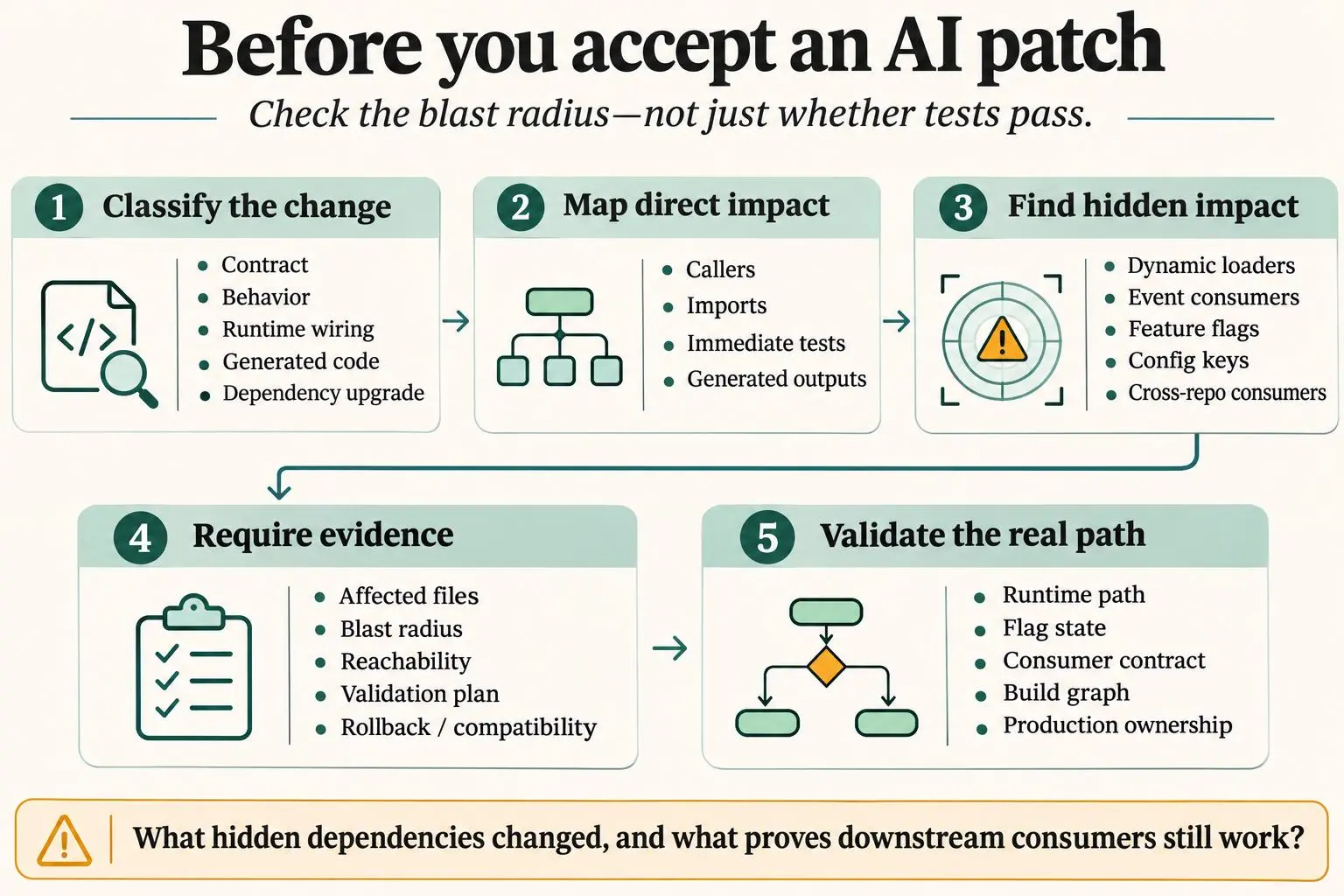
Use this workflow before you accept the edit:
Classify the change
- contract change
- behavior change
- runtime wiring change
- generated artifact change
- dependency upgrade
Map first order impact
- direct callers
- direct imports
- immediate tests
- generated outputs
Map hidden impact
- dynamic loaders
- event consumers
- flagged paths
- config keys
- cross repo or external consumers
Require evidence
- affected files list
- blast radius summary
- reachability check
- validation plan
- rollback or compatibility plan if contracts change
Validate in the right dimensions
- runtime path
- flag state
- consumer contract
- build graph
- production ownership
A simple PR template can force better habits:
What hidden dependencies did this change touch, and what evidence do we have that downstream consumers still work?
That's a much better question than "did tests pass?"
What Better Context Looks Like in Practice
Useful context for AI isn't "more files." It's structural context.
The kind that changes outcomes looks like this:
- callers and callees
- endpoint usage
- environment variable usage
- production reachability versus test only reachability
- blast radius across modules and repos
- dead code that looks alive because tests touch it
There is early measured evidence that targeted cross-file retrieval can improve coverage without making review slower. In a Meta case study on a production SDK, an augmented agent produced the same five missing-documentation fixes as the baseline during API-reference review, then surfaced four additional cross-file findings the baseline missed. During tutorial validation, it found four more issues: one executable bug, one API-usage improvement, and two missing prerequisites. Across five runs per condition, the retrieval layer reduced wall-clock time by 22% to 34% across the two tasks.
This was a two-task documentation study, not a general benchmark of code-change safety. Still, it illustrates the important mechanism: a system that can retrieve dependency chains can expand what gets checked while reducing the cost of checking it.
Linting and unit tests still matter. We use them. They enforce local correctness and behavior. They do not automatically reveal hidden code dependencies or structural risk. The open source AI Code Quality Framework is good for the linting and testing side of that conversation. It just solves a different layer.
For architecture intelligence, Pharaoh maps repositories into a knowledge graph that MCP clients can query before making changes. If your team wants those checks during review, PR Guard can surface unreachable exports, regression risk, test coverage gaps, and breaking change signals in pull requests.
None of that replaces engineering judgment. That's not the point.
The point is to make software context legible enough that humans and assistants can reason from the same map instead of different fragments.
Conclusion
The problem isn't that AI writes code too fast. The problem is that unseen relationships turn fast changes into shallow ones.
The failure modes are predictable once you look for them: dynamic imports, queues and events, feature flags, implicit configuration, generated code, and cross repo consumers. Different mechanics, same result. The assistant edits what it can see. The system fails where the relationship was hidden.
Before your next refactor or PR, pick one recent AI generated change and run a hidden dependency review against it. Not a full audit. Just one pass through the workflow above.
Once you do that a few times, your mental model changes. You stop asking whether the patch looks clean. You start asking whether the system map is complete enough to trust the patch at all.
Article Record
ReferencesPrimary sources used for this article
- [2608.30300] Update from Hell: Can Coding Agents Survive Hidden Breakage in Dependency Upgrades?
- Code Intelligence: How Our Coding Agents Know What to Do — Momental
- Context-as-AI-Service: Surfacing Cross-File Dependency Chains for LLM-Generated Developer Documentation
- Agentic Generation of AST Transformation Rules for Fixing Breaking Updates
- Byam: Fixing Breaking Dependency Updates with Large Language Models
- DORA Research: 2025
- Managing Downstream Dependencies with the AI Engineer
- Enforcing Architecture in an Agent-Driven Codebase | Phoebe