How to Reduce AI Coding Mistakes: A Practical Guide

How to reduce AI coding mistakes starts with admitting the obvious: the model usually isn't the main problem. Weak repo context is. That's why you get duplicate helpers, weird refactors, and code that looks done but never actually runs.
What matters is giving your agent a map before it writes anything, then checking impact before you trust the diff (boring, yes). A few habits make the difference:
- check whether the logic already exists before asking for new code
- trace who calls a shared function before renaming or rewriting it
- verify the new path is reachable from a real endpoint, job, or entry point
That saves you from cleanup nobody wants.
Why AI Coding Mistakes Happen More Often Than Teams Expect
You’ve seen this one. You ask Claude Code, Cursor, or Windsurf for a quick refactor. The diff looks clean. Later, you find a duplicate validator in another module, a downstream caller that broke quietly, or a feature that was implemented but never actually runs.
Most teams blame the prompt. That’s usually the wrong diagnosis.
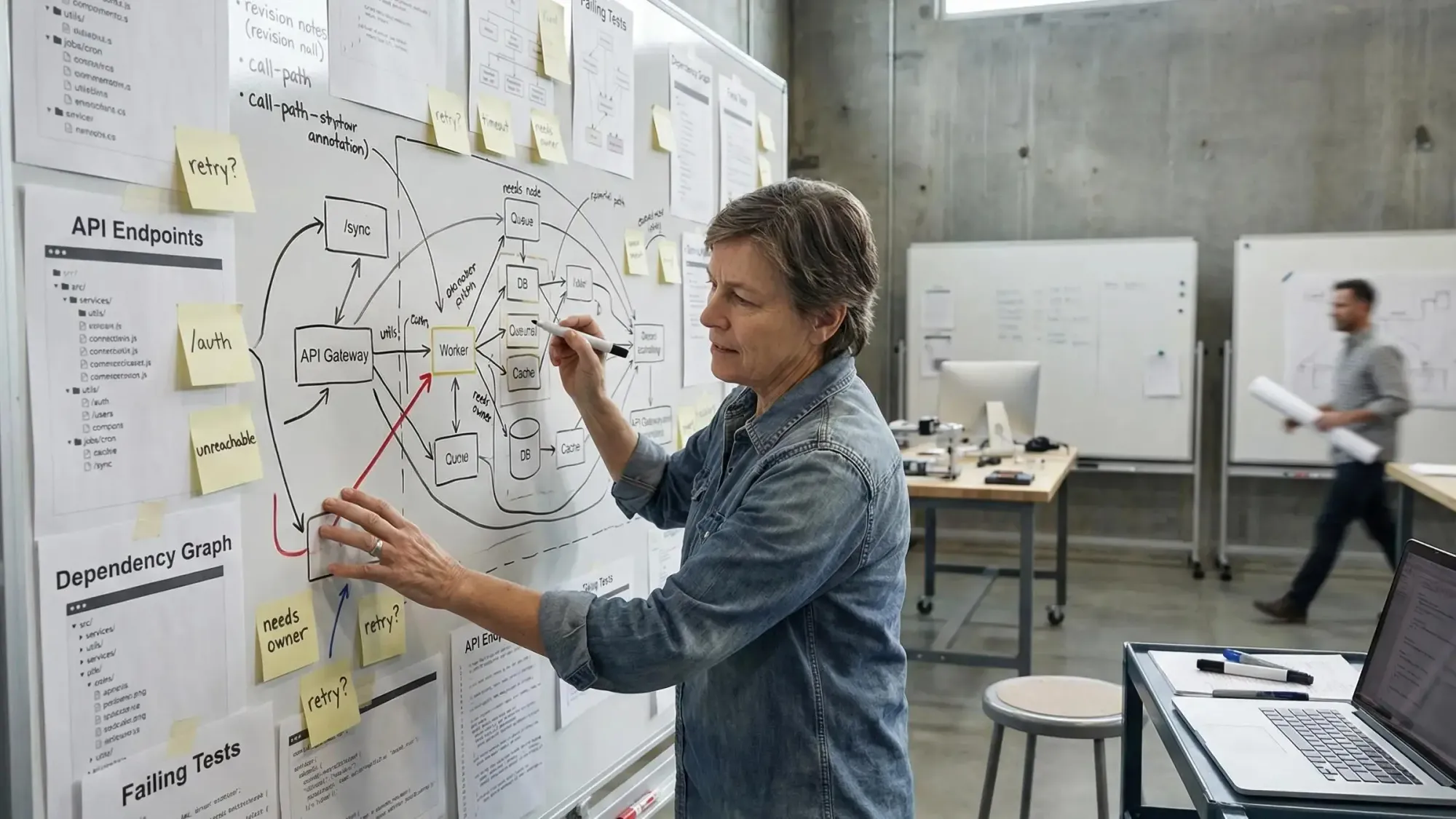
The bigger problem is context blindness. AI tools often read files one at a time, infer structure from partial snapshots, and guess at how the codebase fits together. They can write plausible code without knowing:
- what utilities already exist
- how modules depend on each other
- which endpoints or cron jobs call shared code
- whether a new path is even reachable in production
That creates a dangerous kind of confidence. The code looks right before it’s proven safe.
We’ve found the mistake pattern is less "the model is bad at coding" and more "the model is coding with a weak map." Research around AI-assisted development points in the same direction: over-trusting suggestions, skipping validation, and accepting large diffs too quickly leads to fragile code.
If you want to know how to reduce AI coding mistakes, don’t stop at prompt tuning. Better context plus better process beats a clever prompt every time.
What Reducing AI Coding Mistakes Actually Means
This isn’t about chasing perfect output. It’s about lowering the kinds of failures that cost real time in production.
For AI-native teams, reducing mistakes usually means:
- fewer duplicate helpers and one-off abstractions
- fewer breaking changes during refactors
- fewer features that compile but never get wired in
- less token waste from wandering through random files
- more confidence during PR review and cleanup
There’s a useful distinction here. Syntax-level mistakes are annoying. Architecture-level mistakes are expensive.
A wrong import or small type issue usually gets caught fast. A hidden dependency chain that breaks a scheduled job two modules away can burn half a day. That’s the difference.
Here’s the operating model we use:
Bad AI workflow: generate first, inspect later.
Good AI workflow is the reverse:
- inspect structure first
- generate second
- verify wiring last
That shift sounds small. It changes everything.
The Four Most Common AI Coding Failure Modes
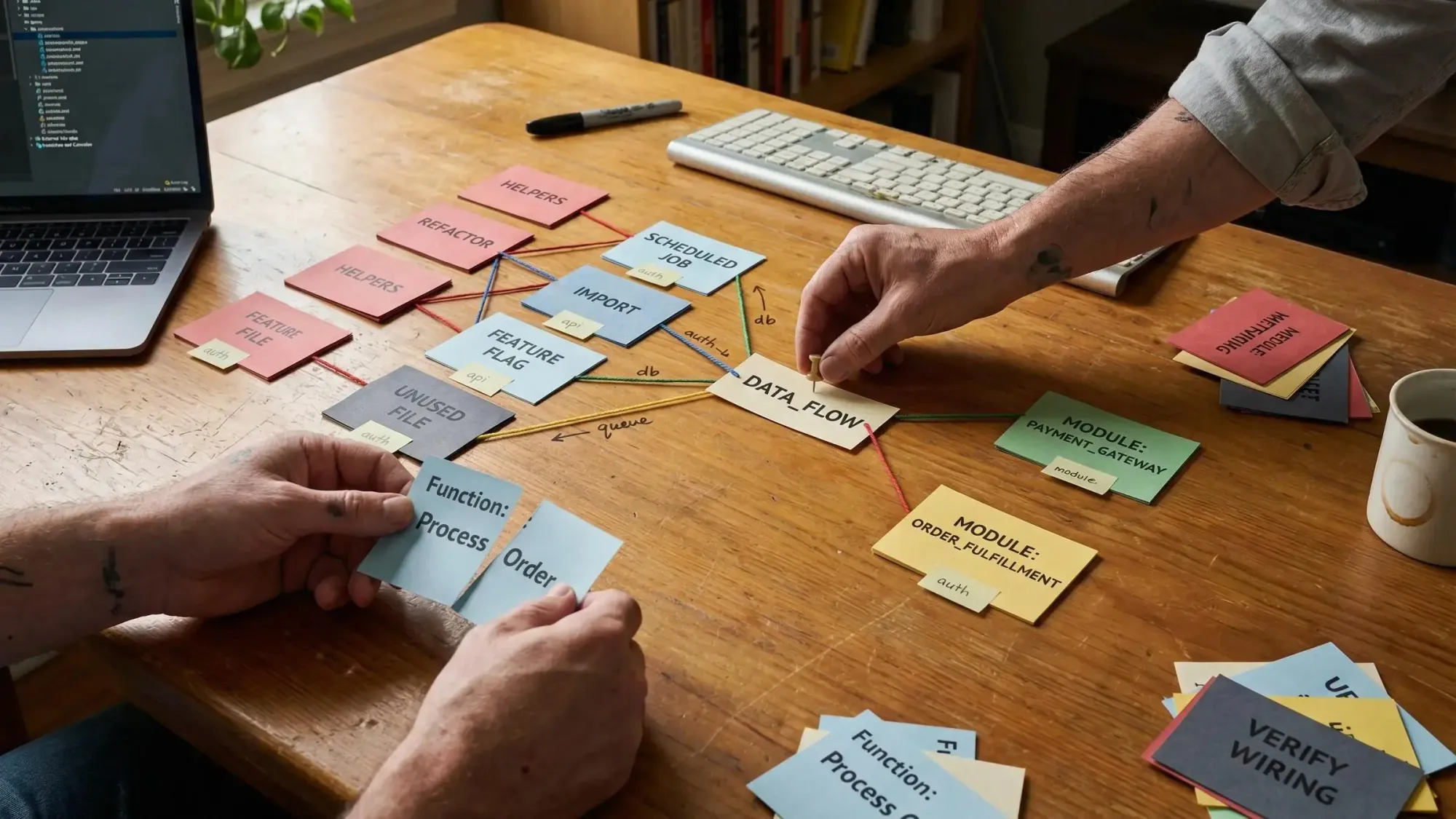
These failures keep showing up because they all come from the same root: the agent can’t see the whole codebase clearly enough.
Duplicate logic
AI writes a new formatter, parser, retry helper, or auth check because it didn’t know one already existed elsewhere. The immediate diff looks productive. Six weeks later, you’ve got drift.
The cost isn’t just extra code. It’s inconsistent behavior across modules and more places to fix the same bug.
Breaking changes during refactors
This is the one that hurts most. The agent updates a shared function but misses transitive callers. Maybe the local tests pass. Meanwhile:
- an endpoint still depends on the old shape
- a cron job imports it indirectly
- another module expects a side effect that disappeared
Refactors fail in the dark.
Orphaned code
AI can implement a feature that looks finished and still never runs. Common examples:
- exported functions with no callers
- handlers created but never registered
- cron logic written but never scheduled
Compiling is not the same as being wired in.
Spec drift
Sometimes docs say one thing and code says another. AI builds from the PRD and ignores current architecture. Or it builds from the codebase and ignores intended scope. Either way, the output is locally sensible and globally wrong.
The shared cause is simple: no whole-repo visibility, no reliable architectural truth.
Start With a Better Mental Model: Treat AI Like a Fast Junior Engineer With Poor Map Awareness
This framing helps because it’s accurate. AI can move fast. It can synthesize code well. It is not a dependable source of architectural truth by default.
That means the right question isn’t "can the model code?"
It’s "what facts did it have before it coded?"
Once you work this way, your behavior changes almost automatically:
- ask for architecture discovery before implementation
- search for existing logic before creating new helpers
- inspect dependencies before refactors
- verify reachability after the change
This is also the part that makes teams calmer. If mistakes come from predictable blind spots, you can design around them. You don’t have to second-guess every diff. You just need a better preflight.
Step 1: Inspect the Codebase Structure Before You Ask AI to Change Anything
Make structural orientation the first step of every AI coding session. Especially in unfamiliar repos, refactor sprints, or bug hunts that cross module boundaries.
The agent should know, up front:
- major modules and their boundaries
- dependency paths between them
- endpoints and scheduled jobs
- where shared utilities live
- which files change often and tend to carry risk
Without that map, the tool burns context window exploring random files and building a shaky mental model. We’ve seen sessions spend 40K tokens just wandering. A graph-backed architecture lookup can shrink that to roughly 2K tokens of useful context.
That’s not just cheaper. It’s cleaner.
If you’re using MCP-compatible tools, a codebase graph gives the agent structure before it starts guessing. Pharaoh maps repos into a deterministic knowledge graph that tools can query before making changes - that’s the core idea behind pharaoh.so. Not the only approach, but the direction is right: map first, edit second.
Step 2: Search for Existing Logic Before Generating New Code
This is one of the highest-leverage habits in the whole workflow. It prevents a surprising amount of mess.
The default failure mode is simple: unless you force discovery first, the agent can’t reliably know whether a helper already exists. So it invents one.
Before asking for implementation, have the agent check for:
- similar function names
- exported utilities in adjacent modules
- existing validation logic
- retry and backoff helpers
- formatting and parsing functions
- auth and permission checks
A few prompt patterns work well:
- "Search for an existing date formatter before adding one"
- "Find current retry logic used by network calls"
- "Locate notification dispatch functions before creating another"
Reuse beats reinvention. For solo founders and teams of 1 to 5, that matters more than people admit. Quiet duplication debt doesn’t stay quiet for long.
Step 3: Run Blast Radius Analysis Before Refactors, Renames, or Deletions
Most code review tools catch problems after the risky change is already written. That’s backwards.
Blast radius analysis means figuring out what depends on a function, file, or module before you touch it. Not just direct callers. Transitive impact too.
This matters when you’re:
- renaming shared utilities
- moving files between modules
- changing exports
- simplifying old helpers that "seem unused"
A useful analysis should show:
- downstream callers by module
- affected endpoints
- cron jobs touched indirectly
- a rough sense of risk
Once a repo is mapped structurally, these lookups are cheap. In graph-based systems, query cost is effectively zero after indexing, which is very different from spending LLM tokens to rediscover architecture on every question. Pharaoh exposes this kind of blast radius analysis through MCP, which makes it practical inside existing agent workflows instead of bolting on another review step.
Step 4: Verify Reachability After Implementation
Unreachable code is one of the most common AI-generated waste patterns. It’s also easy to miss because the code often looks finished.
Reachability is a plain question: can this new function, handler, endpoint, or module actually be reached from a real production entry point?
Common misses:
- exported functions with no callers
- handlers not added to routing
- cron logic written but never scheduled
- feature code added without updating the execution path
This check changes the standard of done. Not "does it compile?" but "does the app have a path that invokes it?"
For fast-moving teams, this should be a pre-PR ritual. If your tooling can trace from production entry points through the graph, you can verify whether the new code is truly wired in. Pharaoh can do that, but the bigger point is the habit. Code that never runs is still a bug. It just hides better.
Step 5: Review AI Changes by Risk Zone, Not by File Count
A 200-line UI copy diff is not the same as a 20-line auth change. File count doesn’t tell you enough.
Review by operational risk instead:
- auth and permissions
- payment flows
- environment variable handling
- deploy config
- migrations
- shared utilities with many callers
Batch acceptance is where teams get burned. The diff looks tidy, the session felt productive, and now a small config change breaks staging two hours later.
A few rules are worth making explicit:
- Low-risk UI changes can move fast.
- Shared utility refactors need dependency review first.
- Infra and env handling always get line-by-line review.
This isn’t anti-AI caution theater. It’s how fast teams avoid expensive recovery work.
Step 6: Use Smaller, Staged Prompts Instead of Long Autonomous Runs
Long autonomous runs feel efficient right up until they aren’t. Vague goals create vague output. Too much autonomy creates drift. Letting an agent run for hours often compounds architecture mistakes instead of finishing the task.
Better looks like this:
- map the module
- search for existing logic
- ask for a minimal change plan
- implement one slice
- run impact and reachability checks
- continue if the path still looks clean
You’re not slowing the agent down. You’re cutting off rework loops before they get expensive.
This also keeps token use sane. The best sessions we see aren’t giant one-shot prompts. They’re short loops with fresh context and hard checkpoints.
Step 7: Add Structural Checks to Your Normal Development Workflow
If this stays a one-off checklist, it won’t last. The goal is to make structural checks part of normal AI-heavy development.
A practical rhythm looks like this:
- at task start: map the relevant codebase area
- before writing code: search for existing functions
- before refactor: trace dependencies and blast radius
- after implementation: verify reachability
- during cleanup: check for dead code and duplication
This fits naturally into Claude Code, Cursor, and Windsurf because it supports the way people already work: iterative sessions, PR review, repo audits, monorepo planning, cross-repo cleanup.
That’s also where we see Pharaoh fitting best. Not as another copilot. More like infrastructure for your existing agents - architectural memory delivered through MCP.
What to Look for in Tools That Claim to Reduce AI Coding Mistakes
You don’t need a long feature matrix. You need a few hard questions.
Ask whether the tool can:
- understand architecture, not just search text
- trace dependencies across modules
- show blast radius before changes
- verify reachability from entry points
- detect dead code or duplicate logic
- work with your current AI tools instead of replacing them
There’s an important distinction here.
Review bots comment after changes. Codebase intelligence helps the agent make better changes before and during implementation.
For small teams, cost shape matters too. If every architecture question burns LLM tokens, you’ll feel it by the second afternoon. Zero per-query model cost after indexing is a real buying criterion, not an implementation detail.
Static linting and tests still matter. They solve a different layer of the problem. For linting, testing, and quality gates, the open source AI Code Quality Framework is a useful companion.
A Practical Workflow for Solo Founders and Small AI Teams
This doesn’t need enterprise process. It needs a clean loop you’ll actually keep using.
A realistic flow looks like:
- Start with a feature request or bug.
- Map the relevant module and dependencies.
- Search for existing logic.
- Ask the agent for a small implementation plan.
- Run blast radius before touching shared code.
- Implement in stages.
- Verify reachability before opening the PR.
- Check for dead code or duplication created by the change.
That’s enough process for a 1 to 5 person team shipping daily. No committee. No paperwork. Just fewer surprises.
The emotional payoff is real. Calmer shipping. Less second-guessing. Fewer moments where a clean diff turns into a bad evening.
Common Misconceptions That Keep Teams Stuck
A few ideas keep repeating, and they waste time.
- Better prompts alone will solve most AI coding mistakes
Prompts help, but once the repo gets non-trivial, architecture visibility matters more. - If the code compiles, it’s probably fine
Duplication, hidden dependency breakage, and unreachable code often compile cleanly. - More autonomy always means more productivity
Long unsupervised runs often create more cleanup than progress. - This is only a big-team problem
Small teams feel it harder because review bandwidth is thin. - Code search is enough
Search finds text. Structural intelligence answers what exists, what depends on it, and what will break.
The pattern underneath all of these is the same. Teams treat AI errors like intelligence failures when they’re often map failures.
Quick Checklist: How to Reduce AI Coding Mistakes on Your Next Task
Use this on your next task without changing your coding assistant.
- Map the relevant part of the codebase before generating code
- Search for existing functions and shared logic first
- Break the task into smaller steps instead of one long autonomous prompt
- Check dependency paths and blast radius before changing shared code
- Review changes by risk zone, not just diff size
- Verify new code is reachable from real production entry points
- Run your normal linting, tests, and quality checks after structural checks
- Log recurring AI failure patterns so your workflow improves over time
That’s the practical answer to how to reduce AI coding mistakes. Not more hope. Better structure.
Conclusion
Reducing AI coding mistakes is less about making models smarter and more about giving them a real map of your codebase.
The operating system is straightforward:
- inspect structure first
- search before creating
- trace impact before refactoring
- verify reachability after implementation
- review by risk
On your next Claude Code, Cursor, or Windsurf task, add one structural check before coding and one verification step after coding. That alone will change the quality of the session.
If you want that codebase map available to your agent through MCP, Pharaoh is one way to add it without changing your current tool stack - pharaoh.so.