9 Ways MCP Server Codebase Intelligence Transforms AI Devs
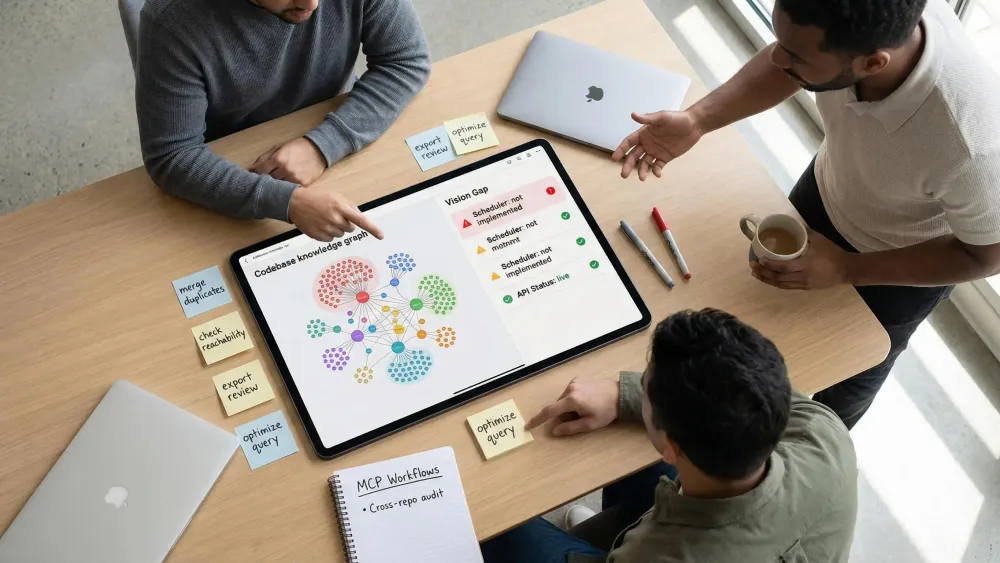
Duplicate code, context rot, agents missing how your codebase fits together—AI-native teams face these every day. mcp server codebase intelligence changes this by giving your Claude Code, Cursor, Windsurf, or Copilot agents direct, architectural truth through graph lookups, not blind file scraping.
This article breaks down nine field-tested ways to upgrade your AI workflows with deterministic codebase awareness,
practical for any solo founder or small team working against the clock.
1. Instant Codebase Mapping as a Knowledge Graph
Get a high-resolution view of your repo, not a shaky guess. Stop burning tokens scouring for context. With real codebase intelligence, your workflow changes fast.
Key advantages of knowledge graph mapping:
- Architectural Blueprint on Demand: Our parsing turns TypeScript and Python code into a structured Neo4j knowledge graph. This includes modules, files, imports, exports, functions, endpoints, cron jobs, DB access, and environment variables.
- Token Savings and Immediate Truth: Your agents see a 2K-token architectural map, not a noisy 40K-token text grab.
- Real-Time Visibility, Always Current: Automatically maps on each push to your main branch.
- Zero Per-Query LLM Cost: You pay only for the initial mapping, then retrieve insights instantly through graph queries.
- Ready for Small, Fast Teams: You and your teammates get instant repo orientation and fast onboarding with every context shift.
Using Pharaoh as the driver, you get MCP endpoints that snap directly into Claude Code, Cursor, and Windsurf, supplying true ground-truth architecture. Unlike Grep or LSP, which show fragments or single file scans, our graph reveals transitive dependencies, bidirectional links, and live churn data.
Structured context means your agents start with architectural intent, not guesswork.
Start every sprint with get_codebase_map for instant repo heatmaps, or use get_module_context for precise module insight. Both run through the Model Context Protocol, with docs and sign-up at modelcontextprotocol.io and Pharaoh.

2. Function Search That Prevents Reinventing Utilities
Duplicate code frustrates every AI-native dev. When your agent rewrites utilities already sitting elsewhere, your product slows down and team energy drains.
Accurate, Graph-Based Utility Discovery
Search the whole codebase at the function level and see through re-exports, barrels, and file aliases. Our function search instantly resolves the full import/export web.
Best-fit use cases for function-level search:
- You want to avoid writing yet another date formatter, parser, or data validator.
- Prompts shrink, agents work smarter. The function's signature, export status, async flag, complexity, and callers are mapped before code is written.
- With tools like
search_functions, you requestparse,validate, ornotifyand instantly grab re-usable utilities, regardless of module or nesting.
Traditional Grep pulls up keywords everywhere. Our graph search draws real dependencies, distinguishing true function lineage and use context.
Get importable functions, not string matches, and deliver smarter code changes with less bloat.
Lean in before you scaffold new features or when requirements hint at existing behaviors. Surface exact or highly confident matches, caller counts by file, and witness if a function is on a critical path.

3. Blast Radius Analysis That De-risks Refactors
Refactoring blind is like walking through a maze in the dark. One missed dependency, and production breaks.
Safe Refactoring, Clear Impact
Our get_blast_radius tool quantifies risk before you change a single line. It spots direct and transitive callers, highlights vulnerable endpoints and scheduled jobs, and tracks impact up to five call hops away.
Instances where blast radius analysis is non-negotiable:
- Renaming a shared helper? See every function, module, or cron job affected — grouped by depth, risk, and path.
- Reviewing a PR with major changes? Quickly rank urgency and focus review attention where risks flow through multiple modules.
- Compare this with Grep, which stops at direct hits. We go further by revealing every downstream consumer, even those buried under layers of indirection.
Get risk scores, map affected HTTP routes or jobs, and don’t let unknown dependencies derail your sprint. Add this as a pre-flight step and start shipping with confidence.
4. Reachability Checking That Proves Production Wiring
How many times have agents (or humans) written code that never runs in prod? Or shipped an export that just sits, unused, adding weight and confusion to the codebase?
Reachability: What Gets Used, What Doesn't
Our check_reachability detects which exports are truly wired into production flows — through HTTP, CLI, cron, or event handlers. It flags modules as entry points, reachable, or orphaned.
Use reachability to:
- Prevent orphaned code before merging. Run this after new implementations or before wrapping an agent session for clear usage assurance.
- Filter review attention for newly added exports that aren’t wired into any route or job.
- Grep shows text appearances; our scans prove the path from each export to live endpoints and jobs, making wiring failures visible before they hit production.
Confirm with certainty that what you just built actually reaches a user or job in production.
Optionally, pull complete traversal paths to check how a shared utility connects across services or modules. Confident code, right from main.
5. Dead Code Detection You Can Finally Trust
Dead code confuses agents, bloats prompts, and slows every future refactor. Most teams never trust their unused code tools — until they see graph-backed results.
Unclutter Your Repo With Proof
We use get_unused_code to combine graph reachability with text reference checks, assigning Dead, Likely Dead, or Alive categories.
Dead code confidence tiers:
- Dead: No inbound call paths and zero text references. Safe to cut now.
- Likely Dead: Not reachable from anywhere, but with string matches that may hint dynamic calls or reflection.
- Alive: Fully connected through call graphs or live endpoints.
Legacy tools guess. We give proof. After feature launches or major refactors, prune helpers, clear out failed experiments, and shrink your AI agent prompts.
Graph-driven dead code detection delivers safe, high-confidence cleanups.
Use this cleanup pass to keep your codebase lean and make every agent session sharper.
6. Vision Gap Analysis That Keeps Specs Honest
Most teams fight a constant battle between what’s in their PRDs and what gets built. Specs drift, code diverges, and suddenly your agent suggests building what already exists.
Vision gap analysis brings blinding clarity.
Sync Specs With Reality, Not Just Theory
With tools like get_vision_docs and get_vision_gaps, you compare living, breathing code against your CLAUDE.md, PRDs, or roadmap docs. We analyze which features are spec’d but not coded, and which parts of code are built but not documented.
When to lean on vision gap analysis:
- At sprint planning, cross-check what’s missing before you waste cycles.
- Convert undocumented, complex code into writing tasks so future devs — human or AI — navigate easily.
- For each spec section, you see linked, implementing functions; for major un-documented logic, you pinpoint where to update your docs.
Traditional search can’t match PRD requirements to the exact functions. Our graph-backed correlation means you finally align doc and delivery every time.
Vision gap workflows ensure your specs guide real code — not just wishful thinking.
7. Consolidation Detection for Merge Opportunities
Duplication spreads like wildfire in small teams and grows worse as agents write what they can’t find. Unchecked, your codebase fragments until maintenance stalls.
Consolidation detection exposes the overlap.
Unify Parallel Code, Shrink Surface Area
Our get_consolidation_opportunities clusters duplicate logic — from functions serving the same job in different files, to modules fanning into the same DB tables. You see not just look-alike code, but converging call chains and real usage overlap.
Perfect fit for:
- Combining competing DB access points or merging signature twins polluting your helpers.
- Surfacing convergent imports where parallel consumers could standardize on one utility.
- Tuning with parameters like minimal size or cross-module duplication, so you don’t waste time chasing false positives.
While vector search finds similar text, we map call structures and dependency overlap, pinpointing which clusters to merge. Clean your codebase by merging, one small collection at a time.
Merge candidates found by structure, not just code style quirks.
8. Dependency Tracing That Exposes Coupling and Cycles
Dependency drift kills agility. Hidden cycles and tangled module webs mean even simple features spiral out of control.
Dependency tracing makes these relationships obvious.
Trace True Paths, Break Cycles Early
With query_dependencies, you pull forward and reverse paths between any modules. The graph flags cycles, shared dependencies, and import boundaries at a glance.
Why dependency tracing is a must:
- You see not just direct imports, but all routes through the dependency web, even multi-hop.
- Spot circular dependencies, like between auth and API, before they ship.
- Highlight shared dependencies that could be refactored to stabilize domains and speed up changes.
Old-school import reading is slow and error-prone. Our graph model exposes connections that text search never will, letting you enforce boundaries and plan migrations with clear, visual proof.
9. Cross-repo Auditing That Accelerates Monorepo Planning
For teams with growing fleets of services or those prepping for a monorepo, codebase overlap is a ticking time bomb. Copy-paste debt slows agents and piles up maintenance.
Cross-repo audit finds the doppelgängers.
Compare, Centralize, and Ship With Confidence
get_cross_repo_audit showcases exact duplicate functions, diverged implementations, and even shallow name matches. It doesn’t just list function overlap—our tool computes module overlaps and flags shared environment variables too.
Best times to run a cross-repo audit:
- Before a monorepo move, so nothing gets lost or duplicated in the shuffle.
- When extracting shared libraries for agents to use everywhere.
- During audits, to clean up copy-paste debt and bring functions into shared, manageable packages.
Text search only reveals identical strings—our audit goes further, finding structural overlap and similarity, even if names or file organization changed over time.
Uncover every hit, from exact twins to near matches worth consolidating.
MCP setup and workflow playbooks for AI-first teams
You don’t have time for endless setup or broken tools. We built Pharaoh to offer rapid integration and the deepest repo understanding right out of the box.
Plug and Play: Pharaoh + MCP Steps
- Connect your GitHub repo to Pharaoh. Get instant codebase mapping.
- Add your MCP server endpoint to Claude Code, Cursor, or Windsurf.
- Use tools like
get_codebase_mapandget_module_contextbefore every sprint, PR, or feature launch. - Lean on
search_functions,get_blast_radius, andcheck_reachabilityat every edit and review.
After mapping, every query is instant, no recurring token costs. Pharaoh maps your main branch in minutes, refreshes on every push, and never stores your source code—just structural metadata, always tenant-isolated.
Your day-one playbook:
- Map the codebase for boundaries and hotspots.
- Drill module context before making changes.
- Run blast radius analysis to avoid breakage.
- Confirm reachability and prune unused code after every round.
Stack architectural truth on every agent move—fewer surprises, sharper results.
Conclusion
Codebase intelligence at the MCP server level isn’t nice-to-have. It’s foundational for AI-native developers and small teams attacking ambitious goals. File scraping is tedious, token-heavy, and context-limited. You need clarity, not guesses.
Adopt Pharaoh. Sync every agent with your live repo’s truth. Stop duplicating, start consolidating, and let your agents drive real work with real codebase understanding. Connect your GitHub, configure MCP, and let the graph show you what matters, what breaks, and what to ship next.