How to Use an MCP Server for Advanced Code Understanding
You already know the limits of current AI coding assistants: disconnected code suggestions, repeated logic, and missed architectural context are all too common.
An mcp server for code understanding changes the game by giving your agents a structured, queryable map of your entire codebase.
We see how frustrating it is to ship fast when your tools lack real code awareness. This guide walks you through:
- How an mcp server for code understanding turns your codebase into a machine-readable graph for agents
- The real-world impact of deterministic queries, blast radius analysis, and GitHub-ready integrations
- Critical setup tips for building reliable, privacy-first AI workflows on solo or small dev teams
What Is an MCP Server for Code Understanding?
Take your AI coding workflow to another level. If you want more than generic code completion, you need the right protocol. An MCP server for code understanding is not just another tool. It’s a structured, queryable endpoint tailored for agentic workflows.
MCP at a Glance: Core Pieces You Need to Know
- Standardizes code insights
MCP isn’t vague. It’s a protocol like REST or GraphQL, designed for AI agents to tap directly into your codebase’s structure. No more loose guesses. Your agent gets ground-truth answers, fast. - Gives agents visible tools, not hidden magic
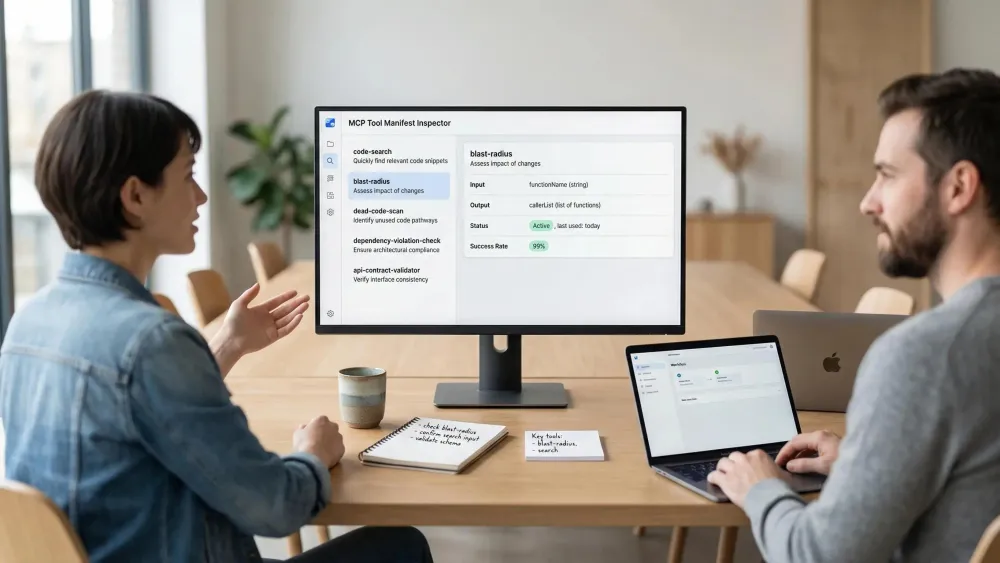
With a tool manifest, every capability is documented. Agents know what analysis tools exist, what input they require, and what output to expect. No gap between what’s possible and what’s allowed. - Enforces boundaries and security
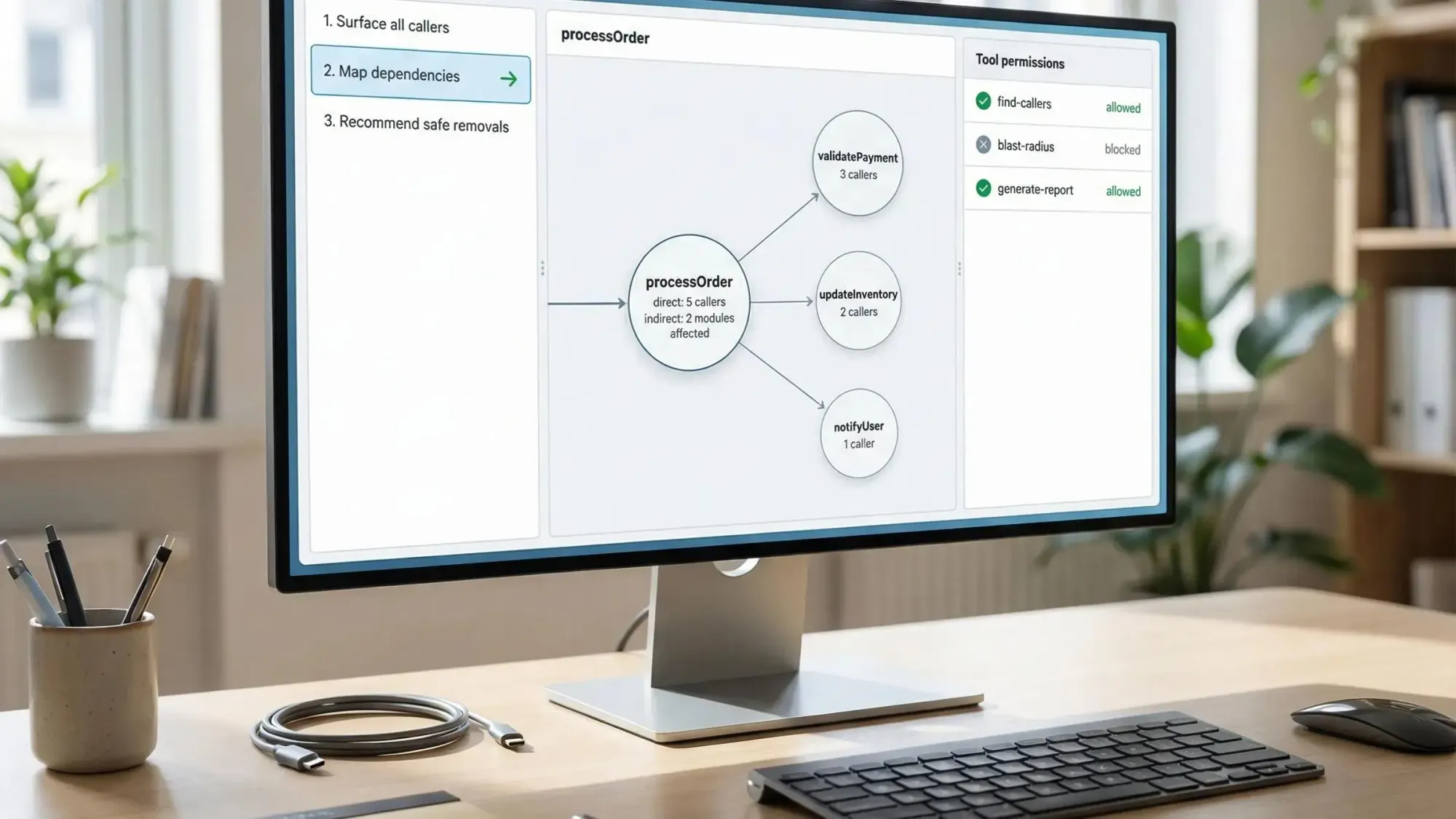
The model acts only on allowed capabilities. Exposed tools (like “find-callers” or “dependency-check”) have strong permissioning by default. Everything stays within guardrails. - Transforms raw code into agent-friendly structure
Instead of raw text, MCP servers deliver rich structural data: call graphs, ASTs, dependency maps. Agents run multi-step analyses—“surface all callers, then map blast radius, then recommend cleanups”—without stumbling over context gaps.
Structured, schema-driven answers. Less noise, more signal for your agent-driven projects.
Why Use an MCP Server Instead of Traditional Code Tools?
Developers driving AI code agents see the same problems repeat: duplication, missed dependencies, breakage outside the current file. Most AI tools only "see" what fits in a window, stripping away context. That’s not enough if you want to move quickly and confidently.
Where MCP Changes the Game
- Deterministic Queries
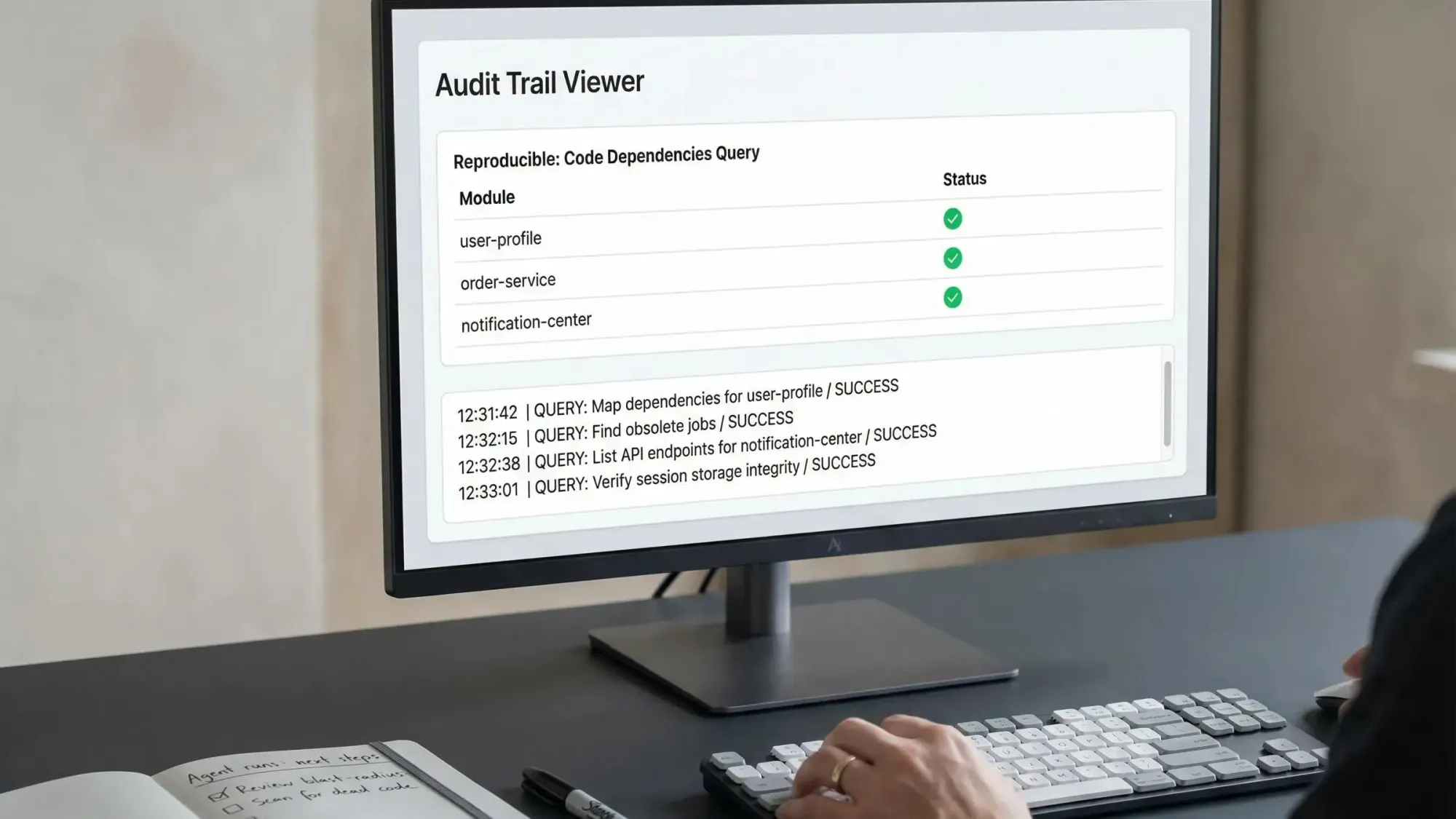
Every call gets a reproducible, auditable answer. No hallucination, no randomness. If your agent asks about module dependencies, it returns the same data every time. - No Token Overhead for Each Query
Once the codebase is mapped, queries happen instantly. There’s no penalty for running batch analyses or forensics across the entire project. - Ground-Truth Architecture
You don’t get similarity matches or fuzzy inferences. You get facts—direct from the parsed source, mapped to a Neo4j graph. - Reproducibility for real-world scale
Large projects like MailKit, with thousands of nodes and tens of thousands of relationships, complete analyses in minutes and offer clarity at scale. - Pharaoh’s Layer
With Pharaoh, your codebase becomes a living Neo4j knowledge graph. AI agents query real architecture, tools like blast radius surfacing every downstream risk, and dead code scans revealing what’s actually obsolete. This is not old-school static analysis. It’s agent-native, audit-ready, and tuned for fast-moving teams who demand confidence each time their AI proposes a change.
How Does an MCP Server for Code Understanding Work?
MCP servers do more than offer static snapshots. They parse, map, and update your codebase dynamically—giving your agents a precise foundation for every decision.
The Key Layers Behind an MCP Server
- Parsing and Extraction
Using Tree-sitter (with WASM support for flexible installs), every function, class, and dependency gets mapped. CRON jobs, env vars, and endpoints are tagged too, enabling holistic workflow support. - Graph Storage
All entities and relationships go into Neo4j. Cypher queries let your agents answer big questions like “Which modules are at risk if I change this function?” or “What code is unreachable or unused?” - Protocol Endpoint
AI tools such as Claude Code and Cursor connect using the MCP protocol. They issue structured queries, get defined JSON results, and avoid the traps of token-bound context. - Reproducibility and Refresh
Auto-indexing keeps the graph fresh with every push. Queries never rely on last-minute LLM guesses. Results are testable, deterministic, and suitable for CI pipelines. - Operational Visibility
Teams gain full transparency with metrics on index speed, node counts, and latency—ensuring confidence in both performance and coverage.
How Do You Set Up and Integrate an MCP Server for Code Understanding?
Getting started doesn’t require weeks of planning. If you’re ready to move, the workflow is straightforward and secure.
Steps to Deploy and Connect MCP for Code Understanding
- Sign up for an MCP-capable platform.
Pharaoh gives you a free starting point. Integration is fast with GitHub App or repo connect. - Complete integration setup.
Grant minimal permissions, choose tenant isolation for your privacy, and let auto-indexing keep everything up to date. - Configure your AI tool’s MCP endpoint.
Claude Desktop, Cursor, and Windsurf support direct MCP connections. Use provided docs and config files for a smooth handshake. - Pick your deployment type.
Choose local for privacy or cloud for team scale. Either way, updates are triggered automatically on git push or merge. - Check language coverage and add custom parsers if needed.
Tree-sitter with WASM helps you expand coverage fast without wrangling native dependencies.
Speed and structure. Parse, map, and connect your codebase to advanced AI agents in under an hour, all while keeping your code secure and your architecture transparent.
Take advantage of deterministic, graph-powered code analysis. Integrate PR Guard for CI checks, or use built-in tools to review, refactor, and govern your repo with confidence. For more technical depth or hands-on setup, check out our blog or official docs—the first step is always the hardest, but we’re lowering the effort so you can unlock real agentic value, faster.
Key Workflows: How MCP Servers Transform AI Coding Agents
If you’re building for speed, maintainability, and high reliability with a small team or running solo, you need workflows that surface the right code facts at the right time—not scattershot guesses. This is where an MCP server for code understanding pays off, powering agents with reproducible clarity instead of guesswork.
High-Impact Workflows for Agent-Accelerated Teams
- Accelerate onboarding
Get developers or agents up to speed in minutes with instant architectural overviews. Map modules, see all endpoints, and hunt for hotspots—no more manual spelunking, just rapid context. - Refactor with confidence
Plan changes by running blast radius and dependency graph queries first. Know in advance which modules or functions your edits will impact—cut surprises and reduce risk by letting the agent map every edge. - Elevate PR review
Run reachability checks, surface code duplication, or flag missing test coverage before merges. Deterministic pre-merge checks, powered by MCP, act as a second set of eyes for small teams who can’t afford post-merge regressions. - Audit and clean up
Dead code and vision gap analysis finds what's unused and what doesn't match your specs. Use scheduled scans or run deep audits when technical debt stacks up—less waste, fewer logic landmines.
Blast radius, dead code checks, code search, and duplication detection—give your AI automated, reliable facts at every step.
Advanced Use Cases and Customization
As your workflows get more complex, you need tools that can keep pace. MCP servers support advanced scenarios that ordinary static analyzers or RAG-based bots can’t handle.
Ways to Fine-Tune Your Codebase Analysis
- Index multiple repos for organization-wide audits, catching copy-paste debt and finding consolidation candidates.
- Link PRDs or specs to your code graph so agents can spot which requirements are missing or incomplete.
- Compose multiple MCP servers for hybrid knowledge—combine code structure, documentation, or secret-scoped analysis, all with strict capability controls.
- Set custom complexity or maintainability thresholds for any module, and kick off targeted refactors when limits are reached.
- Automate compliance: build governance tools that run scheduled policy checks, enforcing boundaries (like “no direct DB calls from the frontend”) using the same graph model.
If you want flexibility, use SDKs or open source helpers to write custom tools that meet your exact patterns, thresholds, and review needs. This is real code intelligence you can tune as your product scales.
Comparing Alternatives: When to Choose an MCP Server for Code Understanding
Choosing tools that truly match your agent-driven workflow can mean the difference between fast, safe shipping and endless regression cycles.
What Sets MCP Apart—And When It Fits Best
- Deterministic, graph-powered answers—every time.
Agents query real architecture, not “lookalike” code snippets. MCP lets you audit, reproduce, and understand every decision. - Zero incremental cost per query after indexing.
Once your graph is built, ping it as many times as you need—compare that with endless embedding costs or ad hoc LLM queries. - Plug-and-play workflow for AI-native tools.
Works out of the box with Claude Code, Cursor, and other leading agentic platforms. Built for seamless integration with GitHub, CI, and team workflows. - Purpose-built for agent-centric shops and doers.
If you care about ship velocity, architectural clarity, and reproducibility more than raw LLM “creativity,” MCP gives your agents power tools that never guess blindly.
For micro-projects or toy scripts, lightweight tools may be enough. But for shipping real products, supporting live users, and building agency into your process, MCP with graph analysis is the move.
Troubleshooting and Best Practices
When you rely on structured automation, you want zero surprises. Proper setup and simple checks keep your graph-powered workflows reliable and secure.
Common Sticking Points and How to Avoid Them
- Double-check integration: verify GitHub App permissions and confirm index jobs succeed after every major push.
- Keep your parsers and token scopes current to handle new language features or repo structure changes.
- Run PR Guard or similar checks before every merge to catch breaking changes before they ship.
- For security, always prefer read-only integrations, enforce tenant isolation, and avoid storing sensitive data within graphs.
Smart workflows scale with discipline. Small weekly habits—refresh, review, and monitor—pay off with fewer bugs and faster code reviews.
If you hit snags, check logs, run smoke-test queries with included tools, or review our setup docs. Step-by-step checklists and active telemetry catch 95% of issues before they cause pain.
Conclusion: Unlock Next-Level Code Understanding With Your AI Agents
AI code agents without structured context will always guess and sometimes fail you. When you use an MCP server for code understanding, the dynamic flips. Now your repo is a living knowledge graph: agent-ready, deterministic, and fast.
You get clarity where before there was chaos. Your agents see the whole picture, your team ships faster, and every review becomes an opportunity for improvement—not risk. Start with Pharaoh’s free tier for solo devs and AI-native teams ready to unlock the next level of code understanding. Bring real architectural intelligence to your AI. Your workflow deserves it.