15 Proven Ways to Prevent Orphaned Code in AI Development

Prevent orphaned code in AI development by shifting your focus from code generation to code connection. This will help you prevent orphaned code ai development.
AI agents can move fast, but without structural checks, it is easy to ship helpers, utilities, and exports that never get used in production.
This playbook pulls together proven ways to verify reachability, align code with intent, and enforce wiring so every function in your repo can make it to a production entry point.
1. Enforce Production Reachability Checks
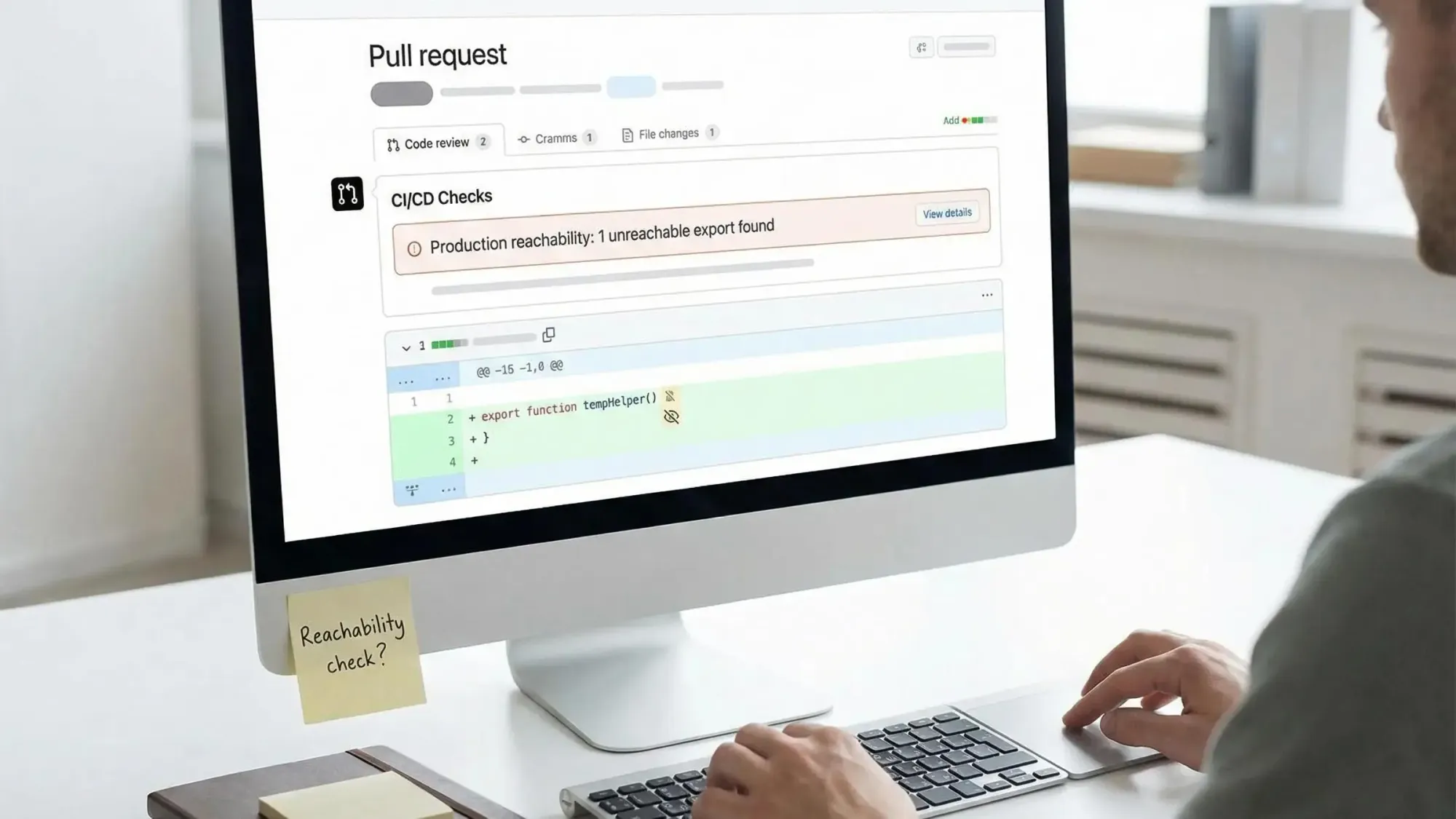
Most code that goes unused in AI-driven repos started out as “almost right." But if no real system or endpoint can call it, it’s dead weight. Kickstart agent-proof code by making reachability your new deployment gate.
- Deterministic results: When every new or changed export gets a reachability check, you see if it actually connects to something live, like an HTTP route or CLI command.
- Reduces agent drift: AI agents tend to write plausible helpers that look fine, but get skipped during wiring. Catch those before they merge.
- Graph evidence over guesswork: Trace the real call chain. Don’t hope a reviewer catches a missing wire—flag it during CI.
- Pharaoh check_reachability: We’ve built this into our toolset. It sorts every function as entry_point, reachable, or unreachable, and shows the exact path. It’s fast, zero LLM token cost after mapping, and returns truth in seconds.
Most orphaned code isn’t a bug, it’s a wiring problem that could have been blocked right at the pull request.
2. Design Entry Points First and Wire as You Go
AI agents guess less and ship better when your repo has visible entry points before the heavy logic lands.
Start every feature or refactor by declaring the concrete input: is this a new HTTP endpoint, cron job, or CLI? Make the agent wire the route or handler before filling in details. Small adjustment. Big payoff. No more silent helpers gathering dust.
Why Entry Points Matter
- Direct connection: Entry points like routes, cron jobs, or handlers provide a guaranteed target for new code.
- No guesswork: Your agents stop inventing utilities in the void—a wiring-first step keeps everything attached to something real.
- Easy for agents: Prompt for the endpoint registration, then pass tests on minimal logic. No need to “read the whole repo.”
Store your wiring conventions in a doc like CLAUDE.md. Help the agent help you by giving it a cheat sheet on “how we plug things into prod.” Our customers see less waste and faster review cycles.

3. Start Every Task With a Codebase Map
Before you jump into task mode, step back and see the battlefield. A codebase map is your navigation layer.
- Zero in on hot files: Identify modules with the most churn, so you know where not to carelessly drop new code that might sprawl into chaos.
- Trace all endpoints: See every handler, route, or queue so you ship features in the right places.
- Avoid architectural knots: A map unmasks dependency tangles. Find where utilities have nested into trouble.
With Pharaoh, that map comes alive. Each module, dependency, route, env var, and blast radius is visualized from the start. Skip the manual file scrape. Prime your agent with a map, save hours, and keep your AI coding tight.
4. Get Full Module Context Before Changing Anything
Every module has a life outside its own file. If you don’t know who calls it, you risk dropping code into the void.
How to Get Real Context
- See the whole surface: Pull up the module dossier: its exports, callers, imports, DB access, endpoints, and cron jobs.
- Follow the call chain: Know exactly which upstream modules depend on what you’re touching. If new logic is better off in a shared utility, spot that early.
- Avoid silent breakage: Snapshots make hidden coupling visible.
With Pharaoh, you keep modules scoped, reviewers informed, and unintended orphans rare—because nothing hides from the graph.
5. Search Before You Write to Avoid Duplicate Helpers
Duplicate helpers are the number one culprit behind orphaned code from AI agents. Don’t let “just in case” helpers grow into a pile of confusion.
Hit the search. Not just a quick grep—filter for exported functions, peel back barrel files, and check partial matches.
- Reuse over rewrite: Prefer importing a utility over making a lookalike. Your agent learns to extend, not duplicate.
- Consolidate: Thin wrappers beat rewrites. If you must change behavior, wrap the canonical logic.
- Pharaoh search_functions: We built deep function search to resolve imports and barrels, surfacing helpers even simple greps miss. This lets you see the real landscape, not just one file.
Every duplicate helper is a future dead end. A tight search loop saves you from decay.
6. Align Vision Documents to Implementations
Get your “why” documents right, and your code won’t drift into dark corners.
Maintain short, living specs or PRDs (like CLAUDE.md or roadmaps) and check often for gaps—what’s built but not specified, and what’s specified but missing in code.
How Vision Drives Action
- Prime your agents: Start prompts with the intent docs, so code follows what matters.
- Trace back every implementation: Each export should map to a business goal or user need, flagged in the doc.
- Built-in wiring checklists: Require that every function can show a wired entry path.
Pharaoh’s get_vision_docs and get_vision_gaps turn vision into traceability. This closes the gap where orphaned logic sneaks in.
7. Add Pre-commit Integration Tests as a Hard Gate
Integration tests must be more than a suggestion. Block the merge if core flows break or a route goes dark.
- Commit gates: Short, high-signal end-to-end flows catch unreachable code the moment it would land.
- Make failure actionable: If the test fails, your agent knows instantly how to adjust and resubmit.
- Faster learn cycles: Small, focused pre-commit tests keep AI agents on track. No more loose ends slipping by.
A blocked commit is your safety net. Warn once, block twice, see code quality rise every time.
8. Ship Small Diffs With a Prompt-to-PR Loop
Big changes create blind spots. Small PRs catch missing wires in minutes.
Ask the agent for small, scoped changes. Run checks. When something fails, prompt for a fix immediately instead of letting problems stack up. Attach reachability output to every PR—reviewers see not just code, but the full call path.
Smaller loops mean fewer orphans, faster feedback, and tighter agent guidance. Don’t wait for review stress to find problems days later. Keep it small, keep it moving, keep your codebase clean.
9. Treat Lint Rules as Law, Not Advice
Set coding standards in stone. This is non-negotiable if you want true architectural discipline, especially when working at AI speed.
Establish architecture and lint rules as errors, not warnings. For example: no cross-layer imports, require validation at boundaries, or disallow default exports for easy searching. Bake in unused export checks or mandatory co-location of tests.
- No hand waving: If it's a rule, make it block commits. An agent, or teammate, will fix errors before code hits main.
- Teach your agents: Add a short summary of your rules in a document like CLAUDE.md. Point prompts toward it.
- Frequent audits: Remove dead rules to avoid confusion and keep enforcement clear.
Treating structure as law keeps orphaned code from sneaking in by accident or oversight.
10. Run Blast Radius Analysis Before You Refactor
Refactoring isn’t just changing files. It’s changing how everything hangs together. Every move can disconnect hidden callers and create stealth orphans.
Always run a blast radius analysis before a significant rename or module extraction. Trace every direct and transitive function call or dependency—see which endpoints, jobs, or services could break.
Why Blast Radius Matters
- Reduce risk: Know if your tweak will break three endpoints or thirty.
- Smart reviews: Group effects by module so reviewers see the big picture.
- Tiered response: HIGH risk? Pair review or gradual rollout. LOW risk? Ship it.
Pharaoh’s get_blast_radius gives this context in seconds, flagging risk and pinpointing affected areas so fixes stay proactive, not reactive.
11. Trace Dependencies and Kill Circular Coupling
Dependency tangles hide problems that will cripple agent productivity and code reachability.
Check both forward and reverse dependency paths between modules. Circles confuse both people and AI agents. When you find circular or tangled connections, split out shared utilities into neutral modules. Make one true home for common logic.
- Explicit ownership: Document rules for dependency direction in your Coding.md.
- Target clarity: Pinpoint where new code can safely live and wire in without risk.
- Cleaner boundaries: No more “which repo does this belong to” debates.
Every circle you break equals one less orphaned export to hunt down later.
12. Schedule Dead Code Cleanup as a Cadence
Dead code isn’t just clutter—it misleads agents, bloats your search surface, and increases future mistakes.
Put dead code detection on autopilot with a set weekly cadence. Target graph-unreachable functions with no text references first; these almost never produce false positives.
- Rapid deletion: Remove safe candidates while context is hot.
- Tag what you trash: Leave notes on public deletions to keep downstream teams in sync.
- Short quarantine: Keep a brief “pending removal” window for tricky services that use strings or reflection.
The tighter your cleanup cycle, the fewer decisions your team has to revisit or regret later.
13. Consolidate Duplicate Logic Before It Drifts
Every duplicate utility or validation splits your codebase’s focus and creates at least one silent orphan.
Systematically detect and merge duplicates—especially where they touch endpoints or validation. Replace forks with adapters that point to a single shared source. Drop a quick deprecation tag on old call sites until you sweep consumers over.
Results of Quick Consolidation
- Reduce drift: One source of truth keeps behavior consistent.
- Faster reviews: Less to check, test, and worry about missing.
- Lower bugs: Fewer places for new orphans to spawn.
Your agents will learn to trust canonical patterns, and your productivity will climb.
14. Audit Cross-repo Duplication During Planning
Orphaned code often starts outside your repo. Before building a new feature, compare with sibling repositories. Look for matching exports, diverging logic, or name overlaps.
- Consolidate or cross-pollinate: Decide whether to extract shared packages or import existing implementations.
- Map env vars and module structures: See instantly if reuse is clean and safe.
- Go beyond the basics: Focus on public APIs and helpers other services might already rely on.
Find and fix duplication before it grows roots—prevent orphans and scale knowledge across your projects.
15. Add a PR Quality Gate That Blocks Unreachable Exports
Every merge should be guarded by structure, not just opinion.
Enable a PR guard that checks reachability from entry points, duplication, regression risk, and dead code exposure. Summarize high-risk changes so senior reviewers can focus where it matters.
The Pharaoh PR Guard GitHub Check Run runs this as part of your workflow—free on advisory, merge-blocking on Pro. Developers see why a change fails, with clear paths to resolve, making code reviews faster and more reliable.
Block first, ask questions second. The right checks keep your repo (and your ship dates) safe from silent failure.
Implementation Checklist and Expert FAQs
Sticking to structural discipline in AI development takes intention and the right toolkit. Here’s how you turn best practice into daily habit.
Rapid Implementation Checklist
- Start with a codebase map and updated module context before coding.
- Prime agents with your CLAUDE.md including conventions and wiring patterns.
- Search for existing functions, route entry points immediately, and limit PRs by scope.
- Attach reachability and blast radius context to every PR, always.
- Treat all structure or lint violations as blockers, not advice.
- Run dead code memos and cleanups weekly.
- Document ownership, vision, and deprecations clearly—help agents and humans keep context.
Conclusion
Preventing orphaned code in AI development comes down to structure, proof, and habit.
Design visible entry points, always search and map before you code, run reachability and blast radius checks, and make pre-commit and PR gates non-negotiable. All of this helps your AI agents (and you) work smarter, not just faster.
When you use graph-based tools like Pharaoh, you build the invisible scaffolding your codebase needs. That’s how solo devs and small teams move at AI speed without sacrificing quality or reliability.
Get started today: map your repo, wire your checks, and give your agents the architectural intelligence they crave.