What Is MCP Model Context Protocol? A Practical Guide
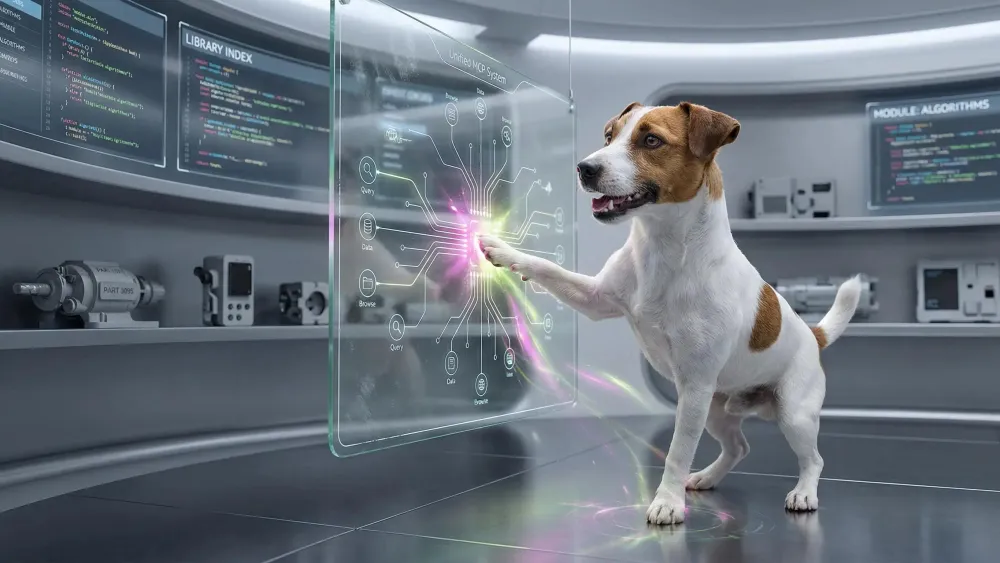
What is MCP Model Context Protocol? gets asked like it's a definition problem. It usually isn't. If you use Claude Code, Cursor, or Windsurf every day, the real issue is your agent still pokes through a repo like a tourist, file by file, guessing at structure and missing what already exists.
What matters is whether your AI can ask the system for grounded context before it edits anything (that's the part people skip). A good setup cuts duplicate code, bad refactors, and dumb token burn fast.
A few things you should care about right away:
- whether the server returns structure, not just search results
- whether your agent can check blast radius before changing shared code
- whether new code is actually reachable when you're done
Read this and you'll stop treating repo context like an afterthought.
The Problem MCP Actually Solves
Your AI coding tool can write code fast. Then it hits the repo and starts wandering. It reads files one by one, misses existing abstractions, and makes changes like someone editing a system they met ten minutes ago.
That's the real problem behind the question, what is MCP Model Context Protocol.
Before MCP, every AI client and every external system needed custom plumbing. Claude to one tool. Cursor to another. A custom agent to a third. If you had 5 AI clients and 6 systems, you weren't dealing with 11 integrations. You were dealing with 30 pairings. That's the N x M mess.
For coding workflows, that mess shows up in very specific ways:
- the AI writes a new retry helper because it didn't know one already existed
- it renames a shared utility without seeing 14 downstream callers
- it burns 40K tokens reading files just to answer a question a graph query could answer in 2K
- it ships code that's never actually reachable from a production path
We've crossed the point where code generation is the bottleneck. It isn't. Context is.
The useful question isn't "can the model code?" It's "can it get trustworthy context before it acts?"

What Is MCP Model Context Protocol?
MCP stands for Model Context Protocol. It's an open standard for connecting AI applications to external tools, systems, and data sources.
A few things it is not:
- not a model
- not a coding assistant
- not a vendor-specific plugin system
- not magic context injection
It's the shared interface between an AI client and outside capabilities.
If the agent is the worker, MCP is the wiring. If the AI is about to refactor a code path, MCP gives it a clean way to ask for the blueprint before it starts pulling on walls.
Anthropic introduced MCP in late 2024. By late 2025, it had spread across major AI ecosystems and moved under foundation stewardship as a vendor-neutral standard. That matters because standards only help if more than one tool takes them seriously.
The promise is simple:
- one protocol
- many clients
- many servers
- less custom integration code
That's why developers care. Not because protocol design is exciting. Because fewer one-off integrations means more useful agents with less glue work.

How MCP Works Under the Hood
Under the hood, MCP is pretty straightforward. It's a client-server pattern with predictable message flow.
The main pieces are:
- Host - the app you're using, like Claude Code, Claude Desktop, Cursor, Windsurf, or a custom agent environment
- Client - the MCP layer inside that host that speaks the protocol
- Server - the external service exposing tools or context
The protocol uses JSON-RPC 2.0 style messages. For transport, local tools often use stdio. Remote services commonly use SSE.
A normal request flow looks like this:
- You ask the AI to do something.
- The model decides it needs outside context or a tool.
- The MCP client calls a relevant server.
- The server returns structured results.
- The AI uses that result to continue the task.
That doesn't make the model smarter on its own. It makes the model less blind.
A weak server still gives weak answers. A deterministic server with good structure gives the model something better than vibes.
Why MCP Matters More for Coding Than for Generic Chat
Generic chat can survive fuzzy context. Code usually can't.
In software work, shallow understanding gets punished fast. The model doesn't just need words from files. It needs structure.
The usual failure modes are familiar:
- duplicate helpers
- missed shared abstractions
- risky refactors with hidden blast radius
- code added in the right folder but never wired into a production path
Reading raw files helps, but only up to a point. A repo isn't a book. It's a system with dependency edges, entry points, call chains, modules, endpoints, and dead branches that still look alive in text search.
The best coding agents aren't the ones that read the most files. They're the ones that can ask better questions of better infrastructure.
That's the shift.
What MCP Servers Actually Provide
An MCP server exposes capabilities, not just text.
Some servers are mostly about action. Others are about understanding. That distinction matters more than people think.
You'll see servers for things like:
- code and repo access
- databases
- project management systems
- communication tools
- browser automation
- internal APIs and custom services
But those break into two very different buckets:
- Action-oriented servers let the AI do things, like create a ticket or send a message
- Context-oriented servers help the AI understand something, like querying schema relationships or inspecting a codebase graph
For development workflows, understanding usually needs to come first. Letting an agent post to Slack is easy. Letting it understand whether a refactor breaks three jobs and two endpoints is harder, and more useful.
The Difference Between MCP and Function Calling, Plugins, or Plain APIs
If you already have APIs, it's fair to ask why MCP matters.
Plain APIs still need custom wiring in each environment. Vendor plugin systems fragment fast. Function calling helps a model invoke structured actions, but it doesn't solve the standardization problem across clients and tools.
MCP sits above that mess. It gives AI tools a common way to:
- discover available capabilities
- communicate in a standard pattern
- reuse integrations across multiple clients
So if your team already has internal services, MCP doesn't replace them. It gives Claude Code, Cursor, and other clients a common interface for using them without rebuilding glue code each time.
That's the practical answer. It's not replacing APIs. It's making them usable by agents in a repeatable way.
What MCP Is Not
A lot of confusion comes from people expecting MCP to solve more than it does.
MCP is not:
- an LLM
- an IDE extension category
- a PR review bot
- a replacement for tests, CI, or source control
- a fix for bad tooling by itself
It solves the connection layer.
That sounds narrow. It is narrow. But narrow infrastructure can still be high impact.
The outcome still depends on the server behind it. If the server only wraps weak search, the agent gets weak context. If the server provides deterministic, well-modeled answers, the agent behaves a lot better.
Protocol matters. Context quality matters more.
A Practical MCP Example for AI Coding Workflows
Let's use a real workflow.
You ask Claude Code to refactor a shared utility. Before changing anything, it queries an MCP server for callers, dependencies, and production touchpoints. The server returns the affected modules and where the function sits in real execution paths.
Now the refactor is scoped. The AI knows what to inspect and what not to break.
Without MCP, the usual path looks like this:
- read a handful of files manually
- run grep and hope naming conventions are consistent
- pull more files into context
- miss a transitive dependency anyway
That blind exploration gets expensive fast. In our world, a graph-backed query can return roughly 2K tokens of targeted context instead of 40K tokens of file reading.
Questions a coding-focused MCP server should answer include:
- Does this function already exist?- What breaks if I rename this utility?- Is this new code reachable from a production entry point?- Where are two modules doing the same thing twice?Those aren't search queries. They're architecture queries.
Why Structured Context Beats Blind File Reading
Not all context is equally useful.
Stuffing more files into the window feels productive, but it often gives you expensive ambiguity. You pay in tokens, and you still don't get a clean answer on transitive relationships or actual reachability.
Blind file reading tends to fail in a few ways:
- high token use
- poor recall across larger repos
- weak handling of multi-hop dependencies
- lots of raw text, not much structural truth
Deterministic structure works better for architecture questions. Parsed metadata and graphs can answer dependency and reachability questions directly, without making the model infer system shape from scattered code fragments.
This is where our view is pretty opinionated: query-time inference is overrated for repo understanding. If you can precompute code intelligence once, you should.
Pharaoh maps a repo into a queryable knowledge graph that AI tools can access through MCP. After the initial mapping, queries are graph lookups with no LLM cost per query. That's a very different operating model from asking the model to rediscover your architecture every session.
Where Pharaoh Fits in the MCP Stack
Pharaoh is one example of a coding-focused MCP server built for architectural context. It isn't an IDE assistant. It doesn't write code. It gives coding agents a map.
We parse TypeScript and Python repos, build a graph of modules, functions, dependencies, endpoints, cron jobs, and env vars, then expose that structure through MCP to clients like Claude Code, Cursor, Windsurf, and GitHub-connected workflows.
That helps in the moments where agents usually get shaky:
- starting in an unfamiliar repo
- checking whether logic already exists
- understanding blast radius before a refactor
- finding dead code
- verifying reachability after implementation
Pharaoh does this automatically via MCP at pharaoh.so.
Real Developer Use Cases for MCP in Codebases
This gets clearer when you anchor it to jobs you already do.
Starting in an unfamiliar repo
Ask for the repo map first. Module boundaries and dependency shape matter before the first edit. By the second afternoon, this usually saves more time than any prompt trick.
Preventing duplicate code
Before the AI writes a helper, have it query whether similar logic already exists. Duplicate code is often a context failure wearing a productivity costume.
Refactoring safely
Check blast radius before renaming shared code or deleting abstractions that look local but aren't.
Verifying implementation
Ask whether the new code is actually reachable from a production entry point. "It compiles" and "it runs in prod" are not the same sentence.
Cleaning up and planning
Use structural queries to find unused exports, duplicate patterns across modules, and dependency chains that block decoupling. During monorepo planning, this gets especially useful.
For broader linting and testing discipline, the open source AI Code Quality Framework is also worth keeping around at github.com/0xUXDesign/ai-code-quality-framework.
How Pharaoh Approaches Codebase Intelligence
The workflow is simple on purpose.
- connect a GitHub repo with read-only access
- parse the codebase automatically with Tree-sitter
- build a graph in Neo4j of functions, modules, dependencies, endpoints, and related structure
- expose that graph through an MCP endpoint
Why this setup works:
- deterministic parsing lowers hallucination risk
- graph queries are good at transitive relationships
- precomputed structure is faster to query than repeated file exploration
The boundaries matter too. Pharaoh does not write code, run tests, or act as a PR review bot. It helps your existing AI tools reason with better context.
That's a cleaner role than trying to be everything.
What Questions a Good Coding-Focused MCP Server Should Answer
If you're evaluating a server, don't stop at "supports MCP."
Ask whether it can answer questions like these, quickly and reliably:
- how is this codebase organized?
- what depends on this module?
- does this logic already exist somewhere else?
- what breaks if this function changes?
- is the new code reachable from a real entry point?
- what exported code appears unused?
- what from the spec hasn't been built yet?
- what's duplicated across repos?
If the answers are mostly text search with nicer packaging, that's not enough. Search is useful. Architecture isn't the same thing.
MCP Adoption Tradeoffs and What to Watch Out for
MCP solves standardization. It doesn't solve operations.
There are real tradeoffs:
- permissions still matter
- stale underlying data leads to stale answers
- text-search servers won't give architectural truth
- dynamic language patterns can make static understanding harder
- good tools still fail under sloppy prompts and workflows
We've seen people treat "has MCP" as the decision criterion. That's too shallow. Evaluate the server design, freshness, permissions, and whether the answers are actually deterministic.
A protocol badge is easy to add. Useful context infrastructure is harder.
How to Think About Token Efficiency With MCP
Token efficiency isn't just about price. It's about attention.
Every time an agent rereads files to re-derive structure, you're spending budget and crowding out room for the real task. That's why repeated repo exploration feels slow even when the model is technically capable.
There are two very different patterns:
- LLM reasoning over raw code at query time, every time
- deterministic lookup against a precomputed structural model
With Pharaoh, a graph query can provide about 2K tokens of architectural context instead of 40K tokens of blind exploration. After the repo is mapped, queries have zero LLM cost on our side.
That usually means:
- faster sessions
- less repeated reading
- more context left for implementation and review
How to Get Started With MCP in a Real Dev Workflow
Don't start with theory. Start with one failure pattern.
- Pick a task where your AI regularly works half-blind.
- Identify the missing context that would've prevented the mistake.
- Connect an MCP server that provides that context.
- Test it inside Claude Code, Cursor, or another MCP-compatible client.
If your pain is codebase understanding, add a graph-backed server first and ask structural questions before asking for edits.
Starter prompts:
- show me how this repo is structured
- does a retry helper already exist
- what depends on this utility
- is my new function reachable from a production entry point
If you're using Claude Code or Cursor, you can add a codebase graph via MCP in about 2 minutes with Pharaoh at pharaoh.so.
Common Misconceptions Developers Have About MCP
A few misconceptions keep coming up.
- "MCP is just another plugin trend."
No. It's a standard interface layer that reduces integration fragmentation. - "MCP makes the AI smart by itself."
No. It gives the AI access to smarter systems. - "MCP is mostly for enterprise workflow automation."
Not really. It's immediately useful for solo developers and small teams living in AI coding tools every day. - "All MCP servers are basically the same."
Not even close. Shared protocol, very different depth. - "Reading more files means understanding the codebase."
It doesn't. Reachability, dependency chains, and architecture are different from file access.
How MCP Changes the Way You Should Think About AI Coding Tools
This is the real mental shift.
Stop thinking of the model as a chatbot that reads files. Start thinking of it as an agent that should consult infrastructure before acting.
For code, that infrastructure should answer architecture questions directly. Dependency maps. Reachability checks. Structural queries. Deterministic analysis.
Most failures people blame on AI coding are context failures. Not all of them, but most. Another prompt tweak won't fix a blind agent nearly as well as better protocol plus better context.
MCP is the connection layer that makes that setup practical.
Conclusion
MCP is the standard that lets AI tools connect to outside systems for grounded context and actions. In coding workflows, its value is simple: less guessing, less repeated file reading, and less wasted token budget.
If you're still asking what is MCP Model Context Protocol, the short answer is this: it's the interface that lets your AI stop acting like a stranger in your repo.
The protocol matters. The context layer behind it matters even more.
Pick one task where your AI currently works half-blind and connect a relevant MCP server. If that task is codebase understanding, adding a graph-backed server like Pharaoh is a practical place to start.