Context-Aware Code Generation for Smarter Developers

If you use Cursor or Claude Code on a real repo, you know how AI code fails. Context aware code generation matters because a clean diff in one file can still break a contract two modules away.
What you need is not a longer prompt. You need call sites, dependencies, and the existing helper the assistant missed (happens a lot).
Check these before you trust the output:
- Did it reuse the right abstraction?
- What downstream modules move with this change?
- Does this belong here, or should you delete code instead?
The Problem Every AI-Assisted Developer Recognizes
You ask Claude Code or Cursor for a small change. It produces a method that looks clean, names things reasonably, even matches local style. Then the PR sits for an extra day because it called the wrong internal helper, missed a contract defined three folders away, or recreated logic that already exists in another module.
That tension is familiar now. We all like the speed. We're also tired of babysitting output that sounds certain without actually knowing the repo.
The issue usually isn't that the model is bad at syntax. It's that the model is working with shallow context. The cleanup lands on you:
- compiler errors that reveal hidden type constraints
- tests that fail for reasons the generated code never considered
- review comments pointing out an existing abstraction it should have reused
- regressions caused by changes with a bigger blast radius than the assistant exposed
That cost adds up fast. By the second afternoon of a refactor sprint, trust starts to drop.
Here's the shift that matters: better AI output usually doesn't come from a bigger model or a longer prompt. It comes from giving the model the right repository and architecture context before it writes anything.
AI is a clever guesser until it can see the system it's guessing inside.
Once you give it dependency awareness, you stop treating it like autocomplete with better manners. It starts acting more like a teammate who at least knows where the bodies are buried.
What Context Aware Code Generation Actually Means
Context aware code generation means generating code from more than the current file or chat prompt. It uses the surrounding signals that determine whether a change actually fits the codebase.
That context is not just "more text." It includes structure, usage, and constraints.
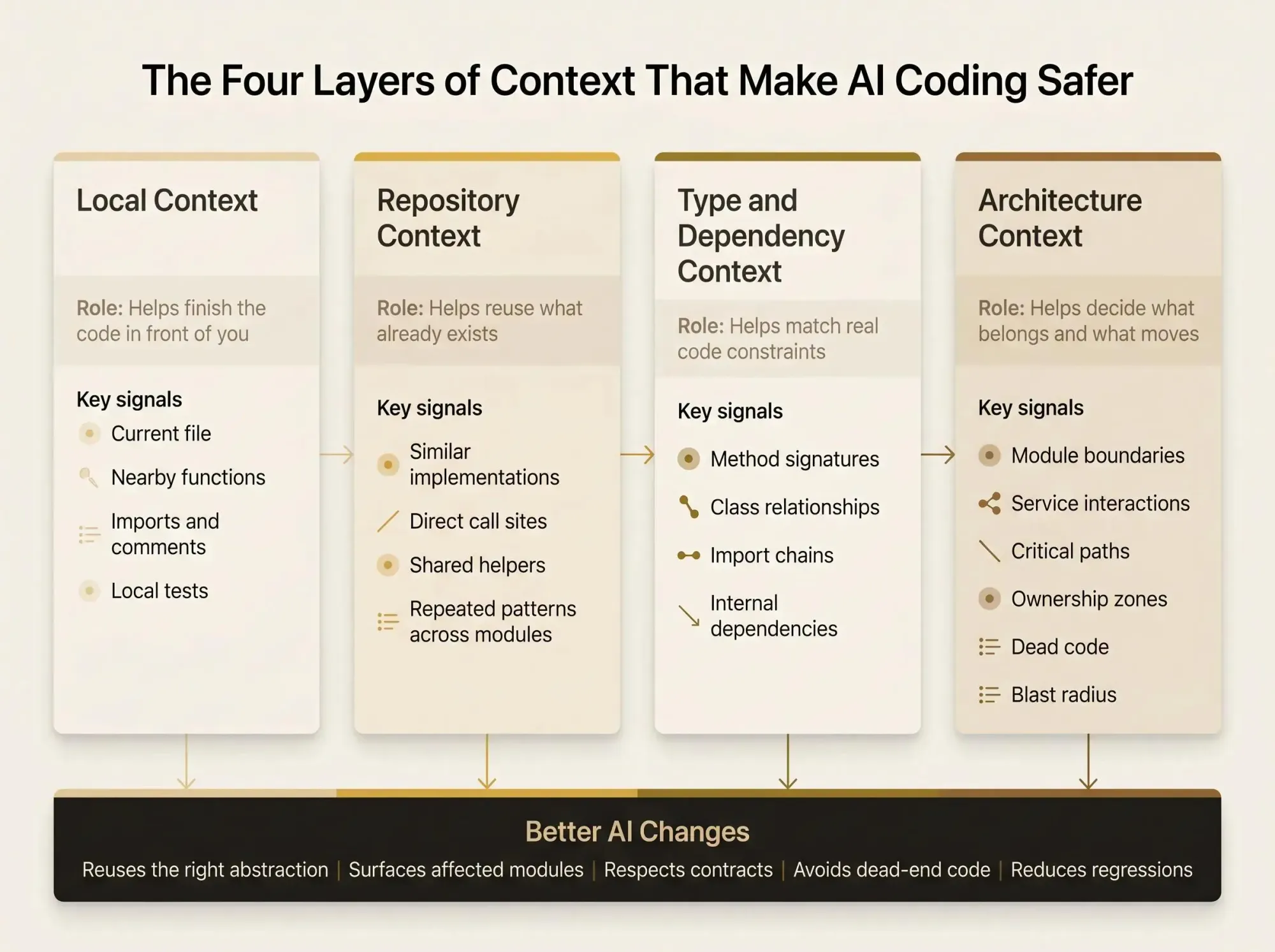
In practice, we see four layers:
- Local context: the current file, nearby functions, imports, comments, tests
- Global context: related files, shared utilities, similar patterns across the repo
- Library and API context: framework rules, package contracts, version-specific usage
- Architecture context: dependencies, module boundaries, ownership, blast radius, dead code
Local context helps the model finish a function. Global context helps it avoid inventing a second version of something you already have. Library context keeps it from using an API incorrectly. Architecture context answers a harder question: should this change live here at all?
That's the practical difference between context aware code generation and prompt stuffing. Stuffing is just cramming more tokens into the window and hoping relevance emerges. Context-aware systems select and organize the signals that actually shape a correct change.
This is where architecture intelligence for coding assistants becomes useful. If you can turn repo structure into something the assistant can reason about, you get fewer plausible mistakes and more code that belongs.
Why File-Level Intelligence Breaks Down in Real Codebases
Single-file completion looks great in demos because demos are neat. Production repos aren't neat.
In real codebases, the right answer often lives somewhere else. The implementation you need may already exist in another module. The correct type contract may be defined far from the file you're editing. The safest change may be deleting code or routing through an existing abstraction, not writing a fresh block.
A few failure modes show up again and again:
- duplicate logic that quietly increases maintenance cost
- valid-looking calls to the wrong internal API
- changes that touch a critical path without saying so
- dead code getting extended because the assistant can't tell it's dead
This is why repository-level generation matters. The assistant needs to know more than what's nearby on screen.
The cleanest way to frame it is ai code generation vs code understanding. Generation can produce syntax. Understanding places code correctly inside a living system. If your assistant only has the first half, you become the second half.
And that gets old.
The Four Layers of Context That Make AI Coding Safer
A useful mental model is to think in layers. Not all tasks need all four, but each layer answers a different kind of risk.
Layer 1: Local intent
This is the immediate editing surface:
- unfinished function
- surrounding class logic
- imports and variable names
- nearby tests or comments
It helps with naming, style, and short-range behavior. Good for filling in a branch. Not enough for shared abstractions.
Layer 2: Repository relationships
Now you're looking across the repo:
- similar implementations
- direct call sites
- shared helpers
- repeated patterns across modules
This is where reuse starts to improve. A lot of bad AI output is just unnecessary novelty.
Layer 3: Type and dependency structure
Here the assistant needs the actual wiring:
- method signatures
- class relationships
- import chains
- internal dependencies
This matters most in statically typed and modular systems. A suggestion can look fine and still violate the shape of the codebase.
Layer 4: Architecture knowledge
This is the layer most teams are missing:
- module boundaries
- service interactions
- critical paths
- ownership zones
- dead code
- likely blast radius
Architecture-aware coding helps answer whether a change should exist, where it belongs, and what else it may disturb.
A simple diagram for your team docs is often enough:
- single-file prompt -> local completion
- layered context -> local + repo + types + architecture
More context isn't always better. Irrelevant context is just prompt noise. The trick is pulling the right layer for the task.
How Context Is Gathered Today: Retrieval, Static Analysis, and Navigation
Teams usually gather context in three ways. Each is useful. None is enough on its own.
Similarity-based retrieval pulls code that looks semantically close to your task. It's good for finding examples and reuse candidates. It struggles when the most important dependency is structurally related but not textually similar.
Static analysis traces code structure: imports, calls, types, references, dependencies. This is the most reliable way to surface what is actually connected. Research across repository-level approaches keeps pointing in the same direction: static analysis gives a strong effectiveness-to-efficiency balance.
Navigation-based exploration lets an agent move through the repo step by step. That can produce strong results on messy tasks because the model can discover context as it goes. The tradeoff is cost. Reported overhead can land around 10x to 20x higher than lighter approaches.
A practical setup often combines them:
- Retrieval for examples
- Static analysis for certainty
- Selective exploration when the structure is ambiguous
If your assistant needs six blind hops to understand one change, you'll feel it in latency and in trust. Fast wrong answers are annoying. Slow uncertain answers are worse.
What the Research Says About Better Context and Better Code
The research here is useful because it confirms what engineers already notice in practice.
When models get local, global, and library context together, generated code tends to show fewer logical errors, less redundancy, and better reuse of existing patterns. That's not a vague quality bump. It's the difference between "looks right" and "fits here."
A few results are worth keeping in your head:
- In Java and Rust tasks, combining retrieved code with type dependency context improved repository-level generation by up to 17.35% over a strong retrieval baseline.
- In Python-focused experiments, iterative refinement with compiler feedback and project context improved dependent code generation by more than 80% over vanilla behavior.
- Call-graph-aware inlining produced gains around 29.73% in exact match, 20.82% in execution success, and 49.34% in BLEU on one benchmark.
- Invocation-aware training improved results too, which tells us caller-callee context matters before and during generation.
The common thread is simple: models do better when they can see how code is used, what it depends on, and what the repo already expects.
Not just what the code says. What the code means in place.
From Context Aware Code Generation to Architecture-Aware Coding
Repository context tells the assistant what's nearby. Architecture-aware coding tells it what matters.
That's the jump. And it's the one that matters most once you're working in monorepos, SDKs, shared platforms, or multi-repo systems where local correctness can still create system-level damage.
In practical terms, architecture aware coding means the assistant can inspect:
- dependency chains before editing
- which modules or services consume a function
- whether a utility is already standardized elsewhere
- whether code is dead and shouldn't be extended
- what the blast radius looks like before implementation starts
There's a useful contrast here:
- retrieval answers what looks similar
- static analysis answers what is connected
- architecture intelligence answers what matters and what not to touch
That's why ai coding with dependency awareness is a better standard than raw completion quality. Code that compiles is cheap. Code that belongs in your system is the hard part.
What a Smarter AI Coding Workflow Looks Like in Practice
This doesn't require a grand rewrite of how your team works. It does require one habit change: gather context before asking for code.
A solid flow looks like this.
1. Start with a concrete task
Pick a real task, not a toy one. Good examples:
- add a feature in a multi-module service
- refactor a shared abstraction
- update an API contract during a monorepo migration
2. Gather minimal local context
Give the assistant the current file, target function, failing error, existing tests, or issue text. Keep it tight.
3. Expand to repository context
Pull in:
- similar implementations
- direct call sites
- related classes
- project conventions
4. Add dependency and architecture signals
Before generation, surface:
- upstream callers
- downstream dependencies
- type constraints
- likely blast radius
5. Ask for options, not just output
This is a small change with big payoff. Ask the assistant to compare reuse vs new implementation, identify affected modules, and flag dead code candidates.
A good prompt shape looks like this:
Summarize dependency impact, existing abstractions to reuse, and likely affected modules before proposing code changes.
6. Validate after generation
Compiler, tests, linting, and review still matter. The open source AI Code Quality Framework covers that side well. But catching architecture problems before code exists is better than catching them after.
Most review tools work downstream. That's backwards for architecture-sensitive changes.
Where a Codebase Graph Fits Into This Workflow
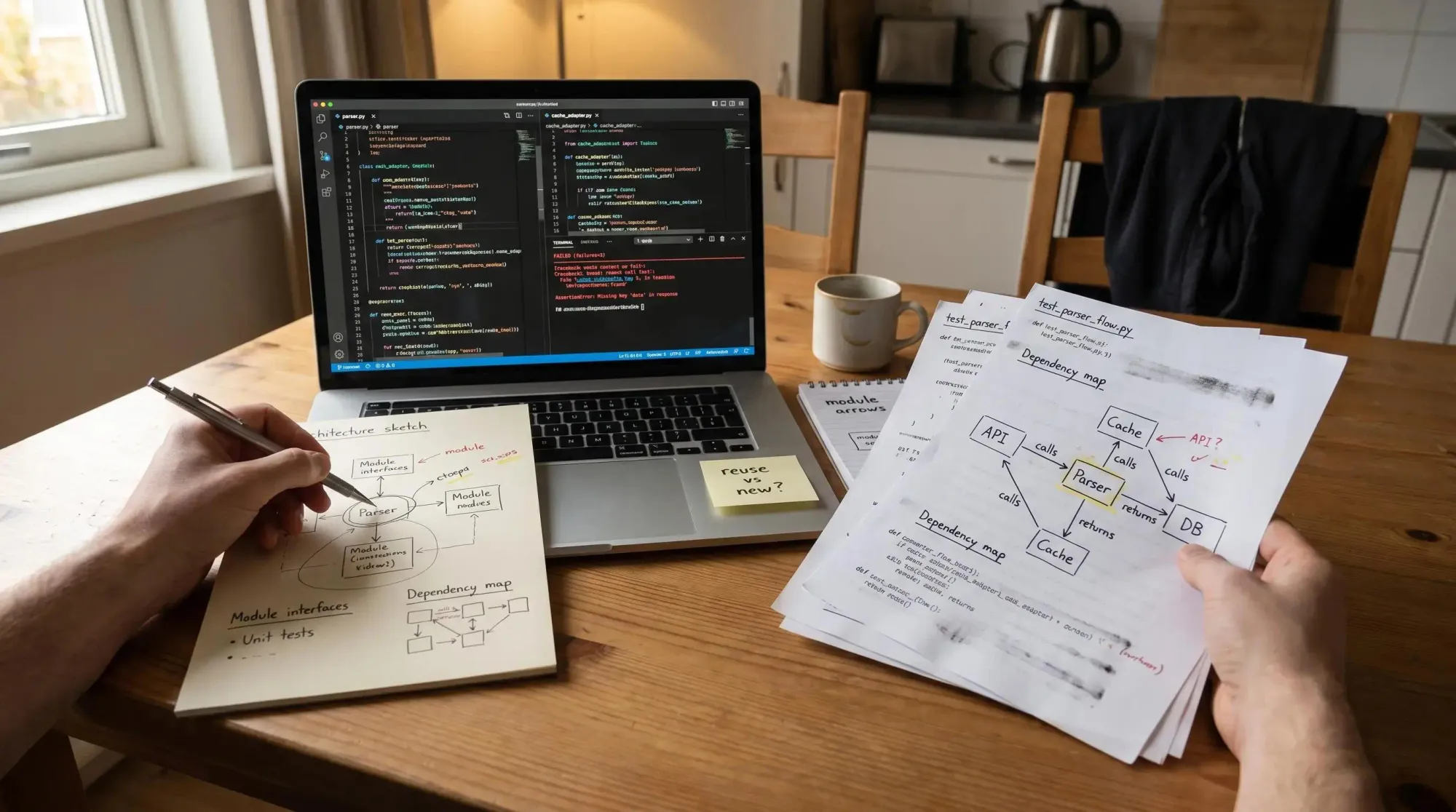
At some point, hand-assembling context stops scaling. That's where a codebase graph helps.
A good graph exposes the things assistants usually miss:
- dependency relationships across files and modules
- existing code paths and reusable abstractions
- probable blast radius of a change
- dead code or low-value paths that shouldn't be extended
We built Pharaoh around this idea. It maps software architecture into a knowledge graph so assistants can reason over the system before edits are made. If you're using Claude Code, Cursor, Codex, or another MCP client, Pharaoh can provide that graph through MCP in a way that fits the workflow you already have. Pharaoh does this automatically via MCP at pharaoh.so.
The important part is what it doesn't do. It doesn't replace the developer. It doesn't magically write correct code. It gives the assistant a living map of the codebase so its suggestions are grounded in actual structure.
That changes the quality of decisions more than most prompt tricks ever will.
Common Use Cases Where Context Pays Off Fast
You don't need to apply this everywhere on day one. Start where context failures already hurt.
New feature work in a mature codebase
The pain is accidental reinvention. The missing context is the existing extension point in another module. The better outcome is the assistant finding and reusing the right path instead of adding a parallel one.
Refactoring sprints
The pain is duplicate cleanup that breaks downstream consumers. The missing context is cross-module usage. The better outcome is spotting repeated patterns across six modules before you touch shared code.
PR review support
The pain is slow review cycles on AI-generated changes. The missing context is architecture fit. The better outcome is a reviewer seeing whether the change follows existing abstractions without spelunking through the repo for 40 minutes.
Monorepo migrations
The pain is hidden fallout. The missing context is dependency chains across packages. The better outcome is knowing which modules will break before the first batch edit lands.
SDK or platform maintenance
The pain is breaking consumers with internal API changes. The missing context is caller spread. The better outcome is understanding which surfaces are actually stable in practice.
Dead-code cleanup
The pain is extending code that should be retired. The missing context is usage reality. The better outcome is removing or consolidating instead of adding.
One of the least obvious wins is this: context often tells you not to generate code at all.
How to Evaluate a Context-Aware Coding Setup
Don't judge a setup by how impressive the demo looks. Judge it by what it prevents.
Use a short checklist:
- Does it find the right internal abstraction instead of inventing a new one?
- Does it respect existing type contracts and usage patterns?
- Can it expose upstream and downstream impact before generation?
- Can it help identify dead code and hidden regressions?
- How much latency does context gathering add inside a normal dev loop?
- Is the context based on real dependencies or just semantic similarity?
- Does it work with the assistants your team already uses?
- Can it handle multi-module or multi-repo work without constant manual prompting?
Track a few before-and-after signals for a month:
- duplicate code found
- regression rate
- review churn
- time spent verifying AI suggestions
If those numbers don't move, your context layer probably isn't grounded enough.
Mistakes Teams Make When They Try to Fix AI Coding with More Prompting Alone
The most common failure mode is simple: teams respond to shallow AI behavior by shoving more text into the prompt.
That usually creates a louder version of the same problem.
Watch for these mistakes:
- dumping huge chunks of repo text into context without ranking relevance
- treating retrieval as enough when dependency structure is the real constraint
- ignoring call sites even though usage shapes correct behavior
- assuming code quality can only be judged after tests run
- overtrusting single-file success metrics on repository-level tasks
- confusing fluent output with actual understanding
- skipping human design judgment about where code belongs or whether it should exist
A clear position here: most code review and quality tools catch problems after the change exists. That's backwards.
You want fewer bad changes entering the system in the first place.
How to Start Small Without Reworking Your Entire Toolchain
Start with one painful workflow. Not ten.
Pick one of these:
- refactors across modules
- bug fixes in shared libraries
- feature work inside a monorepo
Then add one context habit before generation:
- inspect call sites
- inspect dependency neighbors
- inspect similar implementations across the repo
If your team already uses MCP-based assistants, add a codebase graph so the assistant can inspect architecture context before drafting changes. Keep your existing tests, linters, and review process. You're not replacing them. You're reducing the number of bad suggestions that make it that far.
Run a simple experiment this week:
- Take one active task.
- Run it with only local file context.
- Run the same task with repository and dependency context.
- Compare reuse, correctness, and reviewer confidence.
You should feel the difference quickly. Often it's visible in the first session.
Conclusion
Context aware code generation isn't about getting AI to write more code faster. It's about grounding generation in the relationships, constraints, and architecture that make code belong.
That's the real win. Less time cleaning up plausible but risky output. More time making intentional changes with confidence.
Pick one task this week and inspect the dependency context before you prompt your assistant. Compare that result to your normal workflow. If you're already working in Claude Code or another MCP client, adding a codebase graph is a practical way to test architecture intelligence in real work. Pharaoh is one way to do that at pharaoh.so.