Code Change Blast Radius: Prevent Costly AI Coding Mistakes

Code change blast radius is what trips teams up with AI edits. The diff looks clean, tests pass, and you still can't tell whether that "small" helper tweak will break five callers, a mobile client, or tomorrow's deploy.
What matters is not file count. It's dependency depth, strict consumers, and whether the change is easy to undo when it lands wrong. Start here:
- Check changed symbols first, not just files.
- Trace callers past direct imports into shared types, jobs, and generated clients.
- Separate easy rollbacks from one-way side effects, so you merge with a real answer.
Why This Feels Riskier in the Age of AI Coding
You ask Claude Code, Cursor, or Codex to clean up a shared helper. The diff is tidy. Tests are green. The assistant even explains the change clearly. And you still pause, because you can't answer a simple question:
What breaks if I change this file?
That hesitation is healthy. AI makes local edits fast. It does not automatically understand system-wide impact, ownership boundaries, undeclared dependencies, or rollout risk. In a multi-module or multi-repo codebase, one edit can cross package boundaries, API contracts, build steps, analytics models, and production workflows before anyone notices.
We've seen the pattern enough times now. AI-assisted changes can make it to production, look fine at the code level, and still trigger high-blast-radius outages. One reported retail incident ran for hours and pushed the team toward requiring senior approval on AI-assisted changes. That wasn't a syntax problem. It was a context problem.
Most failures aren't code-gen failures. They're architecture failures.

What Code Change Blast Radius Actually Means
Code change blast radius is the full set of code paths, modules, services, tests, contracts, and workflows that could be affected if a change is wrong. Not just the file you touched. Not just direct imports.
A useful definition has to include the messy parts:
- Transitive dependencies
- Runtime behavior
- Fallback paths
- Deployment order
- Side effects you can't easily undo
A one-line CSS tweak might be low risk even if it touches a shared file. A shared auth middleware change can affect every request path in the system. A database migration or API contract change can reach the whole app and be painful to reverse even when the implementation is technically correct.
That's the part teams often miss. Blast radius matters even when the code itself is good. Review scope depends on it. Testing scope depends on it. Rollout strategy depends on it. Rollback planning definitely depends on it.
Understanding code change blast radius is how you turn AI-assisted coding from a gamble into an engineering decision.
Why AI-Generated Code Often Misses the Real Risk
AI usually fails in a very specific way. It generates plausible code for the average case, while your system breaks on the weird case hidden in your architecture.
The output often looks polished. That's part of the problem. Research on AI-generated bugs keeps pointing to a wide spread of defects and quality issues. Even when the code compiles and passes a few tests, trust erodes because the mistakes show up in places the model didn't reason about.
On real teams, the misses tend to cluster around the same traps:
- Optimistic error handling
- Missing fallbacks
- Bad assumptions about callers
- Using the wrong module or wrong function signature
- Changes that fit one file while violating a system contract
We've also learned the hard way that "give the model more files" isn't a serious answer. Dumping a whole repo into context often buries the three files that matter under token noise. In practice, 2K focused tokens beat 40K noisy ones.
The assistant doesn't need your whole repo. It needs a map of the relevant relationships.
What Breaks if I Change This File
This is the question developers ask in the middle of a PR review, a refactor sprint, or a tense staging push on a Thursday afternoon. The answer is rarely in one grep result.
When we do dependency blast radius analysis, we inspect it in layers:
- Direct callers and imports
- Transitive callers further up the chain
- Shared types, interfaces, schemas, and generated clients
- Tests covering the changed symbol or its dependents
- Config, env vars, feature flags, and CI jobs
- External consumers like mobile apps, dashboards, webhooks, and partner integrations
A concrete example: adding a field to an auth API may be harmless for tolerant JSON consumers. It may also break a strict mobile deserializer or fail downstream TypeScript builds. Same change. Different consumers. Different outcome.
Another one shows up in data work. Rename one analytics column and you may hit intermediate models, mart tables, dashboards, and executive reporting. The PR says "rename for consistency." The blast radius says "coordinate with three teams."
Then there are side effects. These get underestimated because they're easy to trigger and hard to reverse:
- Sent emails
- Charged payments
- Published webhooks
- Destructive data changes
If a bad change can be rolled back with one deploy, that's one category of risk. If it charges a customer twice, that's another.
Dead code is its own trap. Something can appear connected and still be unused. If you can't see that, you'll overestimate risk and keep junk alive for another six months.
How to Find Blast Radius of a Code Change Before You Merge
You don't need to turn every edit into a research project. You do need a repeatable workflow.
1. Identify changed symbols, not just changed files
Start with the actual units of impact:
- Functions
- Classes
- Exported types
- Routes
- Schema fields
- SQL models
A file is just a container. Risk usually lives at the symbol level.
2. Find all direct references
Look for imports, requires, call sites, inheritance, interface implementations, and generated client usage. This is the obvious part, and it's still worth doing carefully because a lot of teams rush past it.
3. Walk one level deeper
Now estimate downstream impact of code changes by asking:
- Who calls the callers?
- Which services or modules sit behind those entry points?
- Which test suites cover those paths?
One level deeper is where "small refactor" starts turning into "shared contract change."
4. Ask failure-mode questions
For each dependent, force the uncomfortable questions:
- What happens if this throws?
- What happens if the shape changes?
- What happens if latency increases?
- What happens if null or missing values show up?
This is where operator judgment shows up. Passing tests don't answer these questions by default.
5. Classify reversibility
Put the change in one of three buckets:
- Easy to roll back
- Difficult to roll back
- Impossible to undo
If it mutates data, triggers payments, or pushes external notifications, treat it with respect.
6. Expand review and test scope based on findings
Not diff size. Actual impact.
Here's a simple example. Say an AI assistant updates a shared formatting helper.
- Search every import of that helper.
- Inspect each call site for assumptions about nulls, exceptions, and return shape.
- List the tests covering those callers.
- Decide whether this ships to main, staging, or behind a flag.
That takes a few extra minutes. It can save a week of cleanup.
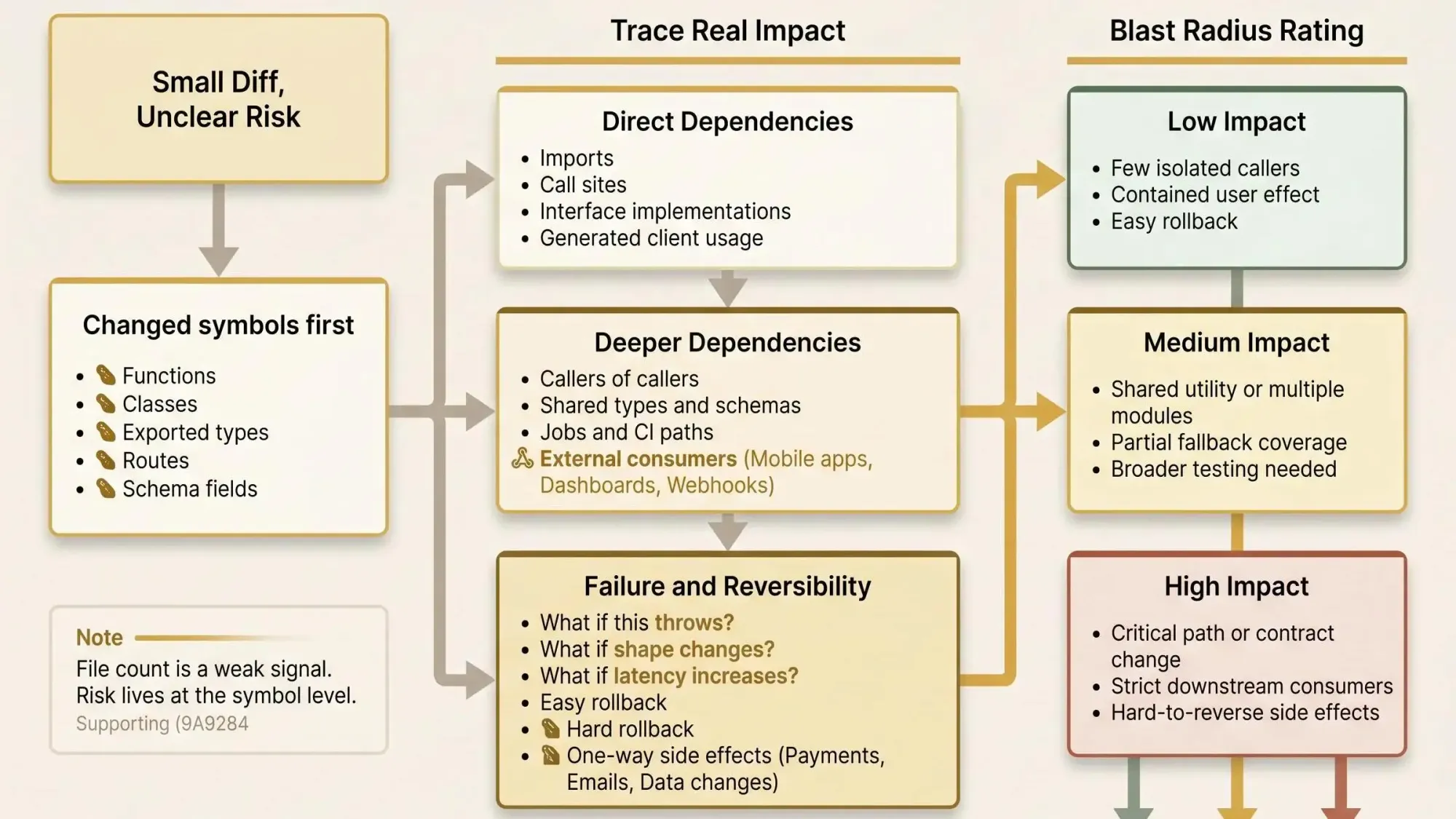
A Simple Way to Estimate Downstream Impact of Code Changes
You need a rating system that's light enough to use in real work. Ours is simple.
Low impact
A few isolated callers. Easy rollback. Local user-facing effect. If it fails, the damage is contained.
Medium impact
Multiple modules or services. Shared utilities. Partial fallback coverage. Usually safe with broader review and targeted testing.
High impact
Critical path code. Many dependents. Contract changes. Hard-to-reverse side effects. These need slower handling even if the diff is tiny.
Caller count alone isn't enough. Five critical callers can be riskier than twenty low-value ones. We score based on a few factors that reflect actual engineering judgment:
- Centrality of the changed component
- Strictness of downstream consumers
- Test coverage on the path
- Deployment order sensitivity
- Reversibility of the change
The mental model is straightforward:
Blast radius = dependency breadth + business criticality + rollback difficulty
If you want a repeatable way to estimate downstream impact of code changes, start there. Not as gut feel. As a review habit.
Impact Scope for Refactors Is Often Bigger Than the Diff
Refactors are where teams get overconfident. The visible diff is mostly renames, moved files, extracted helpers, interface cleanup. It looks safe because it doesn't look like product work.
That's exactly why it bites.
The refactor types that hide real blast radius are boring on the surface:
- Renaming shared functions or fields
- Changing return shapes
- Collapsing duplicate utilities
- Moving modules across package boundaries
- Changing auth, payment, or request middleware
- Shifting schema or data model names
The analytics rename case is a good example. One field change can ripple through intermediate models, mart tables, dashboards, and reporting layers without any dramatic code diff. By the second afternoon, people think the dashboard bug is unrelated. It usually isn't.
Refactors change assumptions, not just structure. They often need broader testing than feature work.
Deletion deserves separate treatment. Deleting dead code is low risk only if you can prove it's dead across the whole graph. If you can't prove that, you're not deleting dead code. You're guessing.
Manual Search, Static Analysis, and Code Graphs Each Solve a Different Part of the Problem
Teams usually try three or four approaches to answer "what breaks if I change this file?" None of them are useless. None of them are enough on their own.
Manual search is fast and familiar. It works for obvious imports and direct references. It misses transitive paths, generated code, dynamic usage, and cross-repo relationships.
Static analysis is stronger for declared dependencies and type-aware relationships. It can produce a useful snapshot for functions, classes, imports, and schemas. It starts falling short when the real dependency only appears at runtime, through config, env vars, or service behavior.
Service catalogs and docs help with ownership and intent. They rarely answer downstream breakage with enough precision to make a risky change feel safe.
Code graphs and knowledge graphs solve a different problem. They map structural relationships into a form humans and AI can reason over, which makes it much easier to narrow context to the files and symbols that actually matter.
The context-size difference is not theoretical. In one graph-based example, review context dropped from 12,507 tokens to 458 in a 125-file repo. In another large framework project, it dropped from 5,495 to 871. The larger the repo, the more expensive blind context loading becomes.
Most code review tools catch problems after they ship. That's backwards. If a change can be mapped before merge, that's when you want the warning.
Why Dependency Blast Radius Analysis Matters More in Monorepos and Multi-Repo Systems
As architecture spreads across packages, services, build systems, and data tools, dependency blast radius analysis gets harder and more necessary at the same time.
The missed relationship types in larger systems are predictable:
- Cross-package imports
- Shared internal libraries
- Generated SDKs
- CI and deployment dependencies
- Infrastructure and config coupling
- Analytics and dbt lineage
One local change can produce very different downstream outcomes. A tolerant consumer ignores the new field. A strict mobile client crashes. An admin build fails because an interface no longer matches.
This isn't just a backend problem. Frontend builds break. Mobile release trains get blocked. Dashboards go stale. Batch jobs fail overnight. Webhooks start drifting.
If you're doing AI-assisted work in a monorepo, don't let the assistant infer dependency structure from a handful of open tabs. The larger the workspace, the less safe that gets.
How to Put Blast Radius Checks Into an AI-Assisted Workflow
This has to fit normal work with Claude Code, Cursor, Codex, and MCP-based tooling. If it's too heavy, nobody will do it after the first week.
A practical workflow looks like this:
- Generate or draft the change.
- Run a blast radius check before refining the implementation.
- Review affected callers and tests.
- Decide on test scope, flagging, rollout target, and reviewer level.
- Merge only after impact is visible.
A prompt pattern that works well is blunt on purpose:
List every file that imports or calls the changed function. For each caller, describe what happens if the new code throws. Rate the blast radius before writing the implementation.
That gets you out of "looks okay" mode and into dependency reasoning.
For team process, a few rules help:
- Require stronger review for high-blast-radius AI-assisted changes
- Route high-risk changes to staging first
- Put blast radius summaries in the PR, not in someone's head
Code quality frameworks still matter for linting, testing, and validation. They just answer a different question. The open source AI Code Quality Framework is useful for that side of the workflow.
When the issue is architectural visibility, Pharaoh is one way to handle it. Pharaoh maps code relationships into a knowledge graph that AI assistants can use through MCP, which helps surface dependencies, existing patterns, and dead code before a change is made.
Where Pharaoh Fits and Where It Does Not
Pharaoh is useful when your problem is architectural visibility. If your problem is simply writing more code faster, that's not the point.
The fit is pretty specific:
- AI-assisted work in multi-module or multi-repo codebases
- Refactors touching shared logic
- PR reviews where blast radius is unclear
- Cases where dead code and duplicate patterns distort decisions
The practical outcome is better context for the assistant, narrower review scope, easier identification of affected dependencies, and more confidence about what to test and who should review.
There are clear boundaries too:
- It doesn't replace developer judgment
- It doesn't fix bugs for you
- It doesn't remove the need for tests, disciplined rollouts, or ownership review
If you're already using Claude Code or another MCP client, adding a codebase graph can make blast radius analysis part of the normal edit loop instead of a separate chore. That's usually the real win.
Common Mistakes Teams Make When They Try to Manage Blast Radius
Most mistakes come from using shortcuts that feel reasonable in the moment. Then the bug report lands.
A few corrections are worth adopting in your next PR:
- Don't assume small diff equals small risk. Tiny changes in central code paths are often the dangerous ones.
- Don't treat passing unit tests as proof of low blast radius. Tests prove what they cover, not what they missed.
- Don't stop at direct imports. Check transitive callers or you'll miss where risk actually concentrates.
- Don't ignore strict downstream consumers. Mobile apps, generated clients, and dashboards often break first.
- Don't trust static scans to reveal runtime coupling. Config, flags, env vars, and deployment behavior still matter.
- Don't let the assistant scan everything and hope for better judgment. More context often means worse signal.
- Don't mix reversible and irreversible changes in your head. A rollback-able UI regression is not the same as a bad payment flow.
- Don't skip blast radius checks during refactors. Refactors change assumptions, even when they don't add features.
- Don't keep dead code forever because nobody can prove safety. Get better graph visibility and make the call.
A useful rule here: if the review says "looks harmless," that's your cue to inspect dependencies, not relax.
Conclusion
Safe AI-assisted development starts when you stop treating a repo like a pile of files and start treating it like a living system of relationships.
Code generation is not the hard part anymore. The missing layer is code change blast radius. That's what lets you move from fast edits to confident delivery.
Before your next AI-assisted PR, do four things: list the changed symbols, find every caller, classify reversibility, and expand the test and review scope to match the actual impact. That's enough to change the conversation.
If that analysis is hard to do by hand in your codebase, Pharaoh is one way to make the dependency map visible before the damage is done.