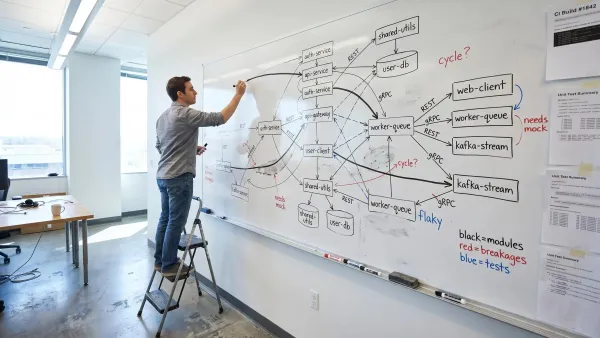
AI coding vs architecture-aware coding in context-aware code generation

Context-Aware Code Generation for Smarter Developers

Context-aware code generation needs more than the current file: four layers of context—local, repository, type/dependency, and architecture—guide changes and reduce blast radius. In real repos, file-level completions often duplicate logic or misuse abstractions, causing downstream breaks. A practica


Dan Greer · · 11 min read
Best software architecture analysis tools for engineering teams

Best Architecture Analysis Software for Engineering Teams

Architecture analysis for AI tools should reveal blast radius, dead code, and how modules connect, not just pretty diagrams. The piece compares Pharaoh (codebase intelligence via a knowledge graph for active editing), ArchAgent (architecture recovery for legacy drift), and SMART (high-level system r

Dan Greer · · 11 min read
MCP developer tools for architecture context enable safer AI coding without guesswork

MCP Developer Tools: Safer AI Coding Without Guesswork

AI coding tools often make risky edits because they operate on a thin slice of code and miss cross-cutting dependencies. MCP developer tools should provide architecture context via a code/knowledge graph that shows dependencies, blast radius, reused patterns, and dead code. The current landscape mix

Dan Greer · · 11 min read
What to include in a software architecture graph: 15 tips for developers

15 Software Architecture Graph Tips Every Developer Needs

The article argues that in large codebases a software architecture graph should reveal dependencies, blast radius, test coverage, and dead code before changes. It urges moving beyond import graphs to include build, test, runtime, and ownership edges with provenance. It advocates layered views (file,

Dan Greer · · 11 min read
Code change impact analysis for safer edits in AI-assisted refactors

Code Change Impact Analysis for Safer AI-Assisted Refactors

AI-assisted refactors fail when the blast radius isn’t visible in the diff, especially in multi-module systems. The article advocates pre-edit impact analysis: define the seed change, enumerate direct and transitive dependents, contracts, and runtime paths, and decide sequencing. It argues that diff

Dan Greer · · 11 min read
How to give Claude Code better project context for safer, faster refactors

Claude Code Project Context for Safer, Faster Refactors

Refactoring with Claude Code in monorepos is risky because changes can affect unseen callers and distant dependencies. Safer edits come from richer repo context, not smarter prompts—layered in-session and persistent rules, per-directory CLAUDE.md, live discovery, and a repo map to reveal blast radiu

Dan Greer · · 11 min read
Code knowledge graphs for software teams enabling safer AI-assisted code changes

Code Knowledge Graph: Safer AI-Assisted Changes

Safer AI-assisted coding comes from a code knowledge graph that encodes real code relationships—files, modules, calls, tests, and contracts—over prompts. It answers who calls what, what depends on it, and which tests are affected, reducing the blast radius of edits. Static analysis is the floor; dyn

Dan Greer · · 11 min read
What architecture intelligence means for software teams in smarter, safer AI coding

Architecture Intelligence for Smarter, Safer AI Coding

AI coding in multi-repo systems is fast but fragile without architecture intelligence—context about dependencies and blast radius must precede edits. A graph-based architecture map shows ownership, connections, and contracts, enabling quick impact questions like what breaks and who’s affected. Use a

Dan Greer · · 11 min read
Sourcegraph Cody alternative for small teams comparison cover

Best Sourcegraph Cody Alternatives for Small Teams

Eight AI coding assistants are evaluated as alternatives to Sourcegraph Cody for small teams, focusing on real workflows over flashy demos. They fall into AI-native editors (Cursor, Windsurf), broad IDE assistants (Copilot), terminal-first (Aider), and self-hosted options (Tabnine, Tabby), plus JetB

Dan Greer · · 13 min read
Using Cursor for large codebases: faster, safer refactors

Cursor for Large Codebases: Faster, Safer Refactors

Large monorepos make Cursor edits risky: a rename can pass local tests yet break a downstream package that shared a hidden type. The article says map context before editing—check shared libs, indirect consumers, and blast radius to ship cleanly. Cursor excels at exact and semantic search with backgr

Dan Greer · · 11 min read